











Water Heaters and Their Types: A Professional Engineer’s Guide to Choosing the Best Water Heater for Your Home

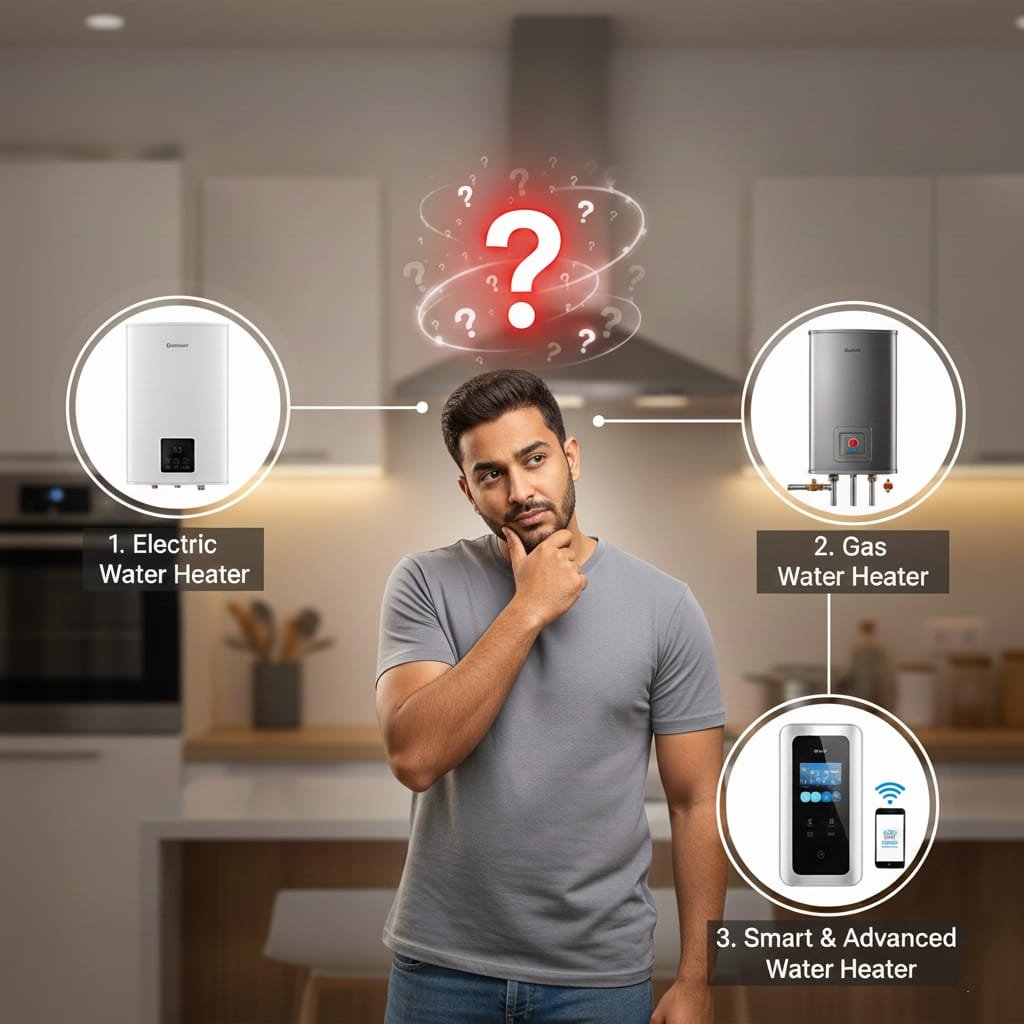
“Water heater” covers half a dozen genuinely different machines that solve different problems. Choosing the wrong type is more expensive than choosing the wrong brand, because no amount of quality compensates for a system that was never designed for your building.
This guide explains every major type, what each is actually for, and the signals that tell you which one belongs in your project.
The Two Questions That Decide Everything
Before comparing products, answer these:
- How many outlets need hot water at the same time? One or two points to a local heater. Several simultaneous points require stored volume.
- What energy source is available and affordable? Electricity, gas, sunlight and ambient air each lead to a different machine.
Everything below follows from those two answers.
1. Storage Water Heaters
The familiar tank. Water is heated and held at temperature, ready to be drawn. Because a reservoir is already hot, a storage heater handles bursts of demand well: two showers in a row do not exhaust it if it is sized correctly.
The trade-off is standby loss. A tank holding hot water loses heat through its walls continuously, and the element fires to compensate whether anyone is home or not. Insulation quality is therefore the specification that most affects running cost.
Best for: homes and apartments with regular daily use. Typical capacities: 30 to 100 litres for a household bathroom. See our residential water heaters.
2. Instant (Tankless) Water Heaters
No storage at all. A powerful element heats water as it flows, so hot water arrives within seconds and continues indefinitely. Nothing sits cooling overnight, which means zero standby loss, the single biggest advantage of the type.
The limitation is simultaneous use. Heating water instantly requires substantial power, and running two outlets at once may exceed what the unit or the electrical supply can deliver.
Best for: single bathrooms, kitchens, guest suites, and properties left empty for long periods. See our instant water heaters.
3. Central Water Heating Systems
A storage system scaled up to serve an entire building from one plant location. One tank, one connection, one maintenance point, hot water at every outlet.
Cost per litre falls sharply as capacity rises, and consolidating into one well-built unit dramatically reduces the maintenance burden compared with a heater in every bathroom.
Best for: villas, apartment blocks, hotels, labour accommodation, clinics. Capacities: 100 to 7,500 litres. See central water heaters.
4. Solar Water Heaters
Rooftop collectors capture solar energy and transfer it into an insulated tank. The fuel is free and permanent, which is why solar produces the largest long-term reduction in water heating cost available in sunny regions.
Two design details separate good systems from disappointing ones. Evacuated tube collectors retain absorbed heat far better than flat plates on cool or cloudy days. And a pressurised tank delivers strong flow at upper-floor taps, where cheap gravity-fed systems produce a weak trickle.
Best for: buildings with unshaded roof area and steady daily demand. Capacities: 100 to 300 litres residential, 500 to 15,000 litres commercial. See solar water heaters.
5. Heat Pump Water Heaters
A heat pump does not create heat, it moves it, extracting warmth from surrounding air and concentrating it into the tank. Because transporting energy costs far less than generating it, a heat pump delivers several units of heat per unit of electricity consumed.
Unlike solar it does not depend on sunshine, so output is predictable year-round and roof area is not a constraint.
Best for: facilities with large, steady demand where running cost dominates. See heat pump water heaters.
6. Industrial Systems: Boilers and Thermal Heaters
Beyond domestic hot water sits process heat. Steam boilers, hot water boilers and thermal oil heaters serve manufacturing, food processing, textiles and district heating, fired by gas, oil, coal, biomass or electricity depending on local fuel economics.
Best for: production facilities and large-scale heating. See our industrial range and steam boilers.
Comparison at a Glance
| Type | Simultaneous use | Standby loss | Best application |
|---|---|---|---|
| Storage | Good if sized right | Yes | Household bathrooms |
| Instant | Limited | None | Single outlets, empty properties |
| Central | Excellent | Yes, reduced by insulation | Whole buildings |
| Solar | Good with storage | Yes | Sunny regions, daily demand |
| Heat pump | Good with storage | Yes | High steady demand |
| Industrial | Process dependent | Managed by design | Production facilities |
Types Can Be Combined
The best specifications frequently mix types. A villa might run solar as the primary source with electric backup in the same tank. A hotel might use a central system for guest rooms and instant heaters for distant service areas. A factory might pair a steam boiler for process with heat pumps for washrooms.
Treating types as competing options is a mistake. They are components you assemble around a building’s actual demand pattern.
Frequently Asked Questions
Which type is cheapest to run?
Over a full year, solar and heat pumps produce the lowest running costs because they use free or multiplied energy. Among conventional options, the cheapest is whichever avoids waste: an instant heater in an empty property, or a correctly sized well-insulated tank in a busy one.
Can one instant heater serve a whole house?
Usually not. Instant heaters excel at one or two outlets. A house running several bathrooms simultaneously needs stored volume from a storage or central system.
Is solar worth it without government incentives?
In high-irradiance regions, generally yes, because the displaced energy cost is significant and recurs daily. The return depends on your energy price, climate and how well the system is sized.
What capacity do I need?
Size on peak-hour demand rather than daily total. A household using two bathrooms within the same hour needs far more stored volume than one spreading the same usage across a day.
Which Type Do You Already Have?
If you are replacing rather than specifying from scratch, identifying the existing system tells you what your building’s plumbing already assumes.
- A cylinder on the bathroom or utility wall — a storage heater, typically 30 to 100 litres.
- A slim flat box with a digital display and no tank — an instant heater.
- A large tank in a plant room or roof space serving the whole building — a central system.
- Panels or glass tubes on the roof with a horizontal cylinder — solar thermal.
- A tank with a fan unit attached that runs periodically — a heat pump water heater.
Replacing like for like is simplest, but a replacement is also the cheapest moment to change type. If your current system never satisfied peak demand, repeating the same specification will repeat the same problem.
Installation Considerations by Type
| Type | Main installation constraint |
|---|---|
| Storage | Wall strength and clearance for anode access |
| Instant | Electrical capacity; draws heavy current while running |
| Central | Plant room space, floor loading, distribution pipework |
| Solar | Roof orientation, shading, structural mounting |
| Heat pump | Air flow around the unit; it needs a heat source |
| Industrial | Fuel supply, flue, water treatment, safety clearances |
Two of these catch people out regularly. Instant heaters are often chosen for their compact size, then found to need an electrical upgrade. And heat pumps must draw warmth from somewhere, so sealing one into a tight cupboard with no air movement undermines the efficiency you paid for.
What Determines Service Life
Across every type, three factors dominate how long the equipment lasts, and none of them is brand.
- What contacts the water. Enamel-coated or stainless steel surfaces resist the corrosion that ends most tanks. Bare steel does not.
- Water quality. Hard or desalinated supply accelerates scale and corrosion, shortening intervals between maintenance.
- Whether anyone maintains it. A consumed anode rod, a seized relief valve or a sediment-covered element will end a good machine early.
Systems without water contact issues, such as solar collectors and heat pump compressors, tend to be limited instead by weather exposure and mechanical wear, which is why frame quality and corrosion-resistant construction matter on rooftop equipment.
Getting the Specification Right
Eau Chauffage manufactures across every category above, from 8-litre compact units to 15,000-litre commercial solar and industrial boilers, under an ISO 9001:2015 certified quality management system.
Tell us the building type, fixture count and occupancy and our engineers will recommend the type and capacity. Email sales@eauchauffage.com or call +1 (905) 299-3382.
Specifying for a business rather than a home? See our guides to commercial hot water systems and industrial steam boilers, where peak-hour sizing and redundancy drive the decision.