











Steam vs Hot Water vs Thermal Oil: Which Does Your Plant Need?

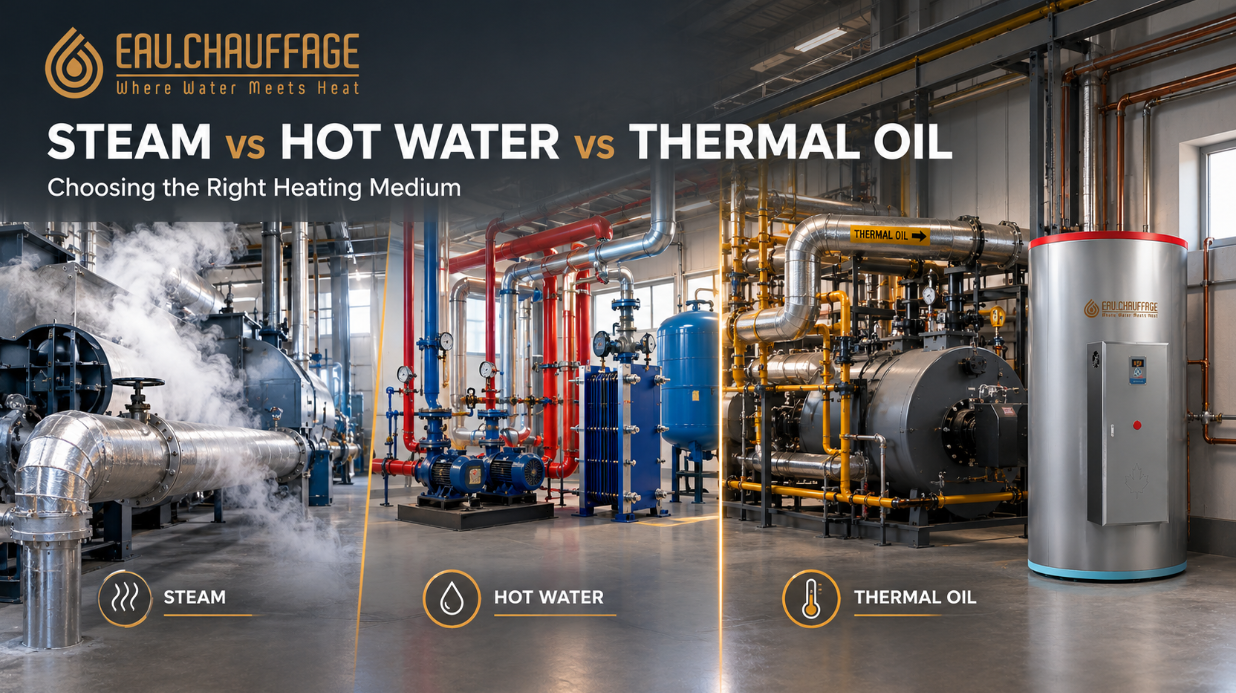
Most plants run steam because the plant before it ran steam. It is the default, it is familiar, and for a great many processes it is genuinely the right answer. But specifying it by reflex is one of the more expensive habits in industrial engineering, because steam brings a pressure vessel, a regulatory regime and a water treatment plant along with it, and a large number of processes need none of those things.
This guide sets out how the choice is actually made: the single physical relationship that decides it, what each medium carries per kilogram, what each one costs you in water and supervision, and which failure modes you are signing up for. It expands the short overview on our industrial steam boilers page into the full decision.
The One Relationship That Decides It
Everything else in this article is detail. The decision itself turns on a single fact of physics:
With water, temperature and pressure are locked together. With thermal oil, they are not.
Water boils at 100 °C at atmospheric pressure. To get steam hotter than that, you have no choice but to raise the pressure, and the relationship climbs steeply:
| Gauge pressure | Saturated steam temperature | Latent heat released on condensing |
|---|---|---|
| 0 bar | 100 °C | about 2,258 kJ/kg |
| 1 bar | 120 °C | about 2,201 kJ/kg |
| 3 bar | 144 °C | about 2,133 kJ/kg |
| 5 bar | 159 °C | about 2,085 kJ/kg |
| 7 bar | 170 °C | about 2,047 kJ/kg |
| 10 bar | 184 °C | about 2,000 kJ/kg |
| 15 bar | 201 °C | about 1,945 kJ/kg |
| 20 bar | 215 °C | about 1,890 kJ/kg |
Read that table twice, because it contains two separate messages. The first is the cost of temperature: a process that needs 200 °C obliges you to hold 15 bar, and 15 bar is a pressure vessel with everything that follows from it. The second is quieter but matters to your fuel bill: the hotter you run steam, the less heat each kilogram delivers. Pushing pressure up to chase temperature costs you latent heat at the same time.
Thermal oil breaks that link entirely. It reaches roughly 300 °C with mineral fluids, and higher with synthetics, while the circuit sits at little more than the pressure needed to pump it round. If your process needs high temperature but not high pressure, that is the whole argument in one sentence.
What Each Medium Actually Is
Hot water
Water circulated below boiling, typically 70 to 95 °C in an open or low-pressure system, or up to roughly 120 °C if the circuit is pressurised. It is the simplest medium to own: modest pressures, ordinary pipework, no steam traps, no condensate system, and operators who need far less specialist training. It suits space heating, washing, and any process comfortably under the boiling point.
Steam
Water taken through its phase change and distributed as vapour. Its defining property is latent heat: when steam condenses on a heat transfer surface it dumps roughly 2,000 kJ per kilogram at constant temperature, without cooling down at all. Nothing else in common industrial use comes close, which is why steam dominates sterilisation, cooking, drying, laundries and textile processing, and why steam can also be injected directly into a product where that is acceptable.
Thermal oil
A heat transfer fluid pumped round a closed loop, heated in a coil, giving up heat as it cools and returning for more. No phase change, no pressure, no water chemistry. It goes hot where steam would need to go high-pressure, which is why it is the standard choice for asphalt, chemical reactors, laminating and hot presses, wood panel plants, edible oil processing and textile stenters.
Heat Carried Per Kilogram: Why the Pipes Look So Different
This is the comparison that explains why a steam plant and a thermal oil plant look nothing alike, and it is rarely put plainly.
| Medium | How it gives up heat | Heat delivered per kilogram circulated |
|---|---|---|
| Steam at 7 bar | Condenses at constant temperature | about 2,047 kJ |
| Hot water, 20 °C drop | Cools down | about 84 kJ |
| Thermal oil, 40 °C drop | Cools down | about 88 kJ |
Steam delivers something in the order of twenty-five times more heat per kilogram than either liquid. That single ratio explains a great deal of what you see on site. Steam mains are small and need no pump, because the pressure that makes the steam also moves it. Hot water and thermal oil circuits are physically larger, carry far more mass per hour and run circulation pumps continuously, and those pumps are a permanent parasitic electrical load that belongs in your operating cost comparison.
The same physics works against oil at the heat exchanger. Condensing steam transfers heat exceptionally well, while a liquid film of thermal oil transfers it far less readily, so an oil-heated exchanger or jacket needs considerably more surface area for the same duty. If you are converting an existing steam-heated process to thermal oil, budget for new heat exchangers rather than assuming the old ones will do.
The Pressure Vessel Consequence
Choosing steam above a low pressure is not only an engineering decision. It is a regulatory one, and the obligations arrive with it whether or not they were in the project budget.
- Design and certification. The vessel must be built to a recognised pressure code. Our pressure vessels are engineered to ASME requirements where the application calls for it, and manufactured under a certified ISO 9001:2015 quality management system.
- Registration and periodic inspection. Most jurisdictions require pressure equipment to be registered and inspected on a schedule, with the plant out of service while it happens.
- Operator competence. Many authorities require a certificated boiler operator above defined thresholds of pressure or capacity. That is a recurring salary, not a one-off.
- Layout and clearances. A boiler house carries siting, ventilation and access requirements that a thermal oil heater in the same duty range often does not.
None of this is an argument against steam. It is an argument against choosing steam without pricing it. For a plant that needs 250 °C, the thermal oil route can remove an entire regulatory regime from the project, and that is frequently worth more than any difference in equipment price.
Two Very Different Ways to Fail
Both media are safe when correctly engineered and both are dangerous when they are not, but they hurt you in opposite ways, and the right choice depends partly on which risk your site is better equipped to manage.
A steam failure is a pressure event. Superheated water released from a pressurised vessel flashes instantly to vapour and expands violently. Steam leaks are also notoriously hard to see and cause severe burns, and a neglected system stores energy continuously, all day, whether or not the process is running.
A thermal oil failure is a fire event. Mineral thermal fluids are commonly operated above their flash point, so oil escaping onto a hot surface or into lagging can ignite. This is a well understood and manageable risk, but it demands things a steam plant does not: leak-tight flanged joints rather than improvised repairs, lagging kept free of soaked oil, and a fire strategy that accounts for a combustible fluid at 300 °C.
A fair summary: steam concentrates its danger in stored pressure, thermal oil concentrates it in flammability. Neither is disqualifying; both belong in the specification conversation rather than the commissioning one.
The Water Question, Which Matters More in This Region
A steam plant is not a closed system, and this is where Gulf sites pay a penalty that plants in wetter climates barely notice.
Steam boilers lose water continuously and have to be topped up. Blowdown alone, the deliberate discharge that keeps dissolved solids from concentrating in the boiler, commonly runs between 2 and 10 per cent of steam production, and it goes up as feedwater quality goes down. Every litre blown down is treated water that you paid to soften, paid to heat, and then threw away hot. Add condensate that is never returned, losses at failed steam traps, and flash steam vented to atmosphere, and the real make-up figure is often considerably higher than the design one.
Across much of Saudi Arabia and the wider Gulf the supply is hard groundwater or aggressive desalinated water, so that make-up water needs treatment before it is fit to enter a boiler. The regional water chemistry and what it does to heating surfaces is covered in more detail on our page about water heaters in Saudi Arabia.
A thermal oil circuit consumes none of this. It is sealed, there is no blowdown, no softening plant, no deaerator, no chemical dosing and no water bill attached to the heating system. Against that, the fluid itself is a consumable with a real price: it degrades in service, it must be sampled and analysed periodically, and eventually it has to be replaced and the old charge disposed of properly. The honest comparison is recurring water and treatment cost on one side against periodic fluid replacement on the other, and which wins depends on your local water price and your operating temperature.
Temperature Control and Response
Steam is controlled by pressure, which makes it beautifully simple: set the pressure and the saturation temperature follows automatically and holds itself steady across the whole surface. It is also fast, because a steam system responds almost immediately when a valve opens.
Thermal oil is controlled by flow and supply temperature, which makes it more adjustable but slower. You can dial in an operating temperature anywhere across a wide band without touching pressure, which processes like laminating and curing genuinely need. The trade-off is thermal inertia: an oil system takes a long time to reach temperature from cold, and just as long to cool down, so it suits continuous operation far better than a plant that starts and stops.
There is a practical consequence worth stating. If your plant runs one shift a day and shuts down at night, the thermal mass of an oil system is working against you every morning. If it runs continuously, that same mass is a stabiliser.
Side by Side
| Hot water | Steam | Thermal oil | |
|---|---|---|---|
| Practical temperature range | Up to about 95 °C, or 120 °C pressurised | 100–215 °C at 0–20 bar | Up to about 300 °C, higher with synthetics |
| System pressure | Low | Rises with temperature | Low at any temperature |
| Pressure vessel regime | Usually not | Yes, above thresholds | Usually not |
| Heat per kilogram circulated | Low | Very high (latent) | Low |
| Heat transfer at the surface | Good | Excellent | Moderate, needs more area |
| Circulation pumps | Required | Not required | Required |
| Water treatment and blowdown | Minor | Significant and recurring | None |
| Freezing risk when idle | Yes | Yes | No |
| Corrosion risk | Yes | Yes | Very low |
| Consumable fluid | No | No | Yes, periodic replacement |
| Start-up from cold | Fast | Moderate | Slow |
| Principal hazard | Low | Stored pressure | Flammability |
| Operator requirement | Low | Often certificated | Moderate |
Choosing by Application
In practice the process requirement decides, not preference. Find your temperature and your constraint, and the medium is usually obvious.
| Requirement | Medium | Why |
|---|---|---|
| Space heating, washing, sanitation under 95 °C | Hot water | No reason to accept pressure or complexity |
| Sterilisation and autoclaving | Steam | Saturated steam is the sterilising agent itself |
| Food processing, cooking, brewing | Steam | Clean, fast, and can be injected directly where permitted |
| Commercial laundry | Steam | High heat flux into presses and tunnel finishers |
| Textile dyeing | Steam | Direct heating of the dye bath |
| Asphalt and bitumen | Thermal oil | Needs well over 150 °C; steam would mean high pressure |
| Chemical reactors | Thermal oil | Precise temperature over a wide band, no pressure |
| Laminating, hot presses, wood panel | Thermal oil | High, stable platen temperature |
| Edible oil processing | Thermal oil | High temperature without a pressure regime |
| Drying with hot air | Hot blast stove | Heats air directly, no intermediate medium at all |
Our industrial range covers all four routes: WNS, LSS, SM, SZS, DZL, SZL, DZH and WDR for steam, WNS, CWNS, DZL and vacuum units for hot water, YYWQ, YLW and MNS for thermal oil, and the HY series for hot air. See the full industrial range.
You Do Not Have to Choose Only One
Plenty of plants run two media, and it is often the cheapest answer rather than a compromise. A factory with a 260 °C press and a staff canteen has no business holding the whole site at 20 bar to serve the press; thermal oil handles the process while a separate, simple system handles the rest.
The reverse arrangement is common too. Where steam is already being raised for a process, a heat exchanger can generate building hot water from it, which avoids a second fuel-burning appliance entirely. The one thing to check before committing to that is summer: if the boiler would otherwise shut down and you keep it running purely to make washroom hot water, you are burning fuel at a very poor efficiency for a small load, and a dedicated unit is cheaper. Our commercial hot water systems page covers that decision, and the same logic applies to staff facilities on an industrial site.
Mistakes We See in Specifications
- Specifying steam for a process under 100 °C. You are buying a pressure regime to deliver heat that hot water would have carried.
- Chasing temperature with pressure without checking the code threshold. The jump from a low-pressure boiler to a registered pressure vessel with a certificated operator is a step change in cost, not a gradual one.
- Converting steam to thermal oil while keeping the old heat exchangers. Oil needs more surface area for the same duty.
- Treating thermal oil as fill-and-forget. It degrades. Sample it, analyse it, and plan its replacement.
- Leaving condensate return out of a steam project. Returning hot condensate is the single largest efficiency item in most steam plants, and retrofitting it costs far more than designing it in.
- Ignoring make-up water cost at the feasibility stage. In a region with expensive or aggressive water, this can decide the whole comparison.
Frequently Asked Questions
What is the main difference between steam and thermal oil?
Steam links temperature to pressure, so higher temperature always means higher pressure and a pressure vessel. Thermal oil reaches roughly 300 °C at almost no pressure. Steam carries far more heat per kilogram and transfers it better; thermal oil avoids the pressure regime and the water treatment entirely.
Is thermal oil cheaper to run than steam?
It depends on what you are comparing. Thermal oil has no blowdown, no make-up water and no water treatment plant, which is a real saving, especially where water is expensive. Against that it runs circulation pumps continuously and the fluid is a consumable that must eventually be replaced. At high process temperatures thermal oil usually wins; near 100 °C steam or hot water usually does.
Can I use hot water instead of steam for my process?
If the process temperature is comfortably below boiling, yes, and it will be simpler and cheaper to own. The limit is not only temperature but heat flux: a process that needs a lot of heat into a small surface may still justify steam even at a modest temperature, because condensing steam transfers heat so much more effectively.
What temperature can thermal oil reach?
Mineral heat transfer fluids are generally used up to around 300 °C, with synthetic fluids going higher. The practical ceiling is set by the fluid you select and by film temperature at the heater coil rather than by the pressure of the system.
Is thermal oil dangerous?
It is a combustible fluid usually operated above its flash point, so leaks onto hot surfaces or into lagging are a fire risk and must be engineered against. It is a well understood hazard, but a different one from steam, which stores its danger as pressure instead.
How much water does a steam boiler lose?
Blowdown alone commonly runs between 2 and 10 per cent of steam production, rising as feedwater quality falls. Unreturned condensate, failed steam traps and vented flash steam add to that, so the real make-up requirement is often well above the design figure.
Can one plant run both steam and thermal oil?
Yes, and it is common. Thermal oil serves the high-temperature process while steam or hot water serves everything else. It is usually cheaper than forcing the whole site onto the pressure needed by one machine.
Tell Us What Your Process Needs
Send us the process temperature, the heat load, how many hours a day the plant runs, your available fuel and your local water conditions, and our engineers will come back with a recommended medium and a configuration to match, including fuel, layout and, where steam is the answer, the feedwater treatment to go with it.
Pressure vessels are engineered to ASME requirements where the application calls for it, and every unit is manufactured under a certified ISO 9001:2015 quality management system. Email sales@eauchauffage.com or call +1 (905) 299-3382. See the full industrial steam boiler range.