











Planning a 100-Villa Project? Here’s How to Choose the Smartest Water Heating System

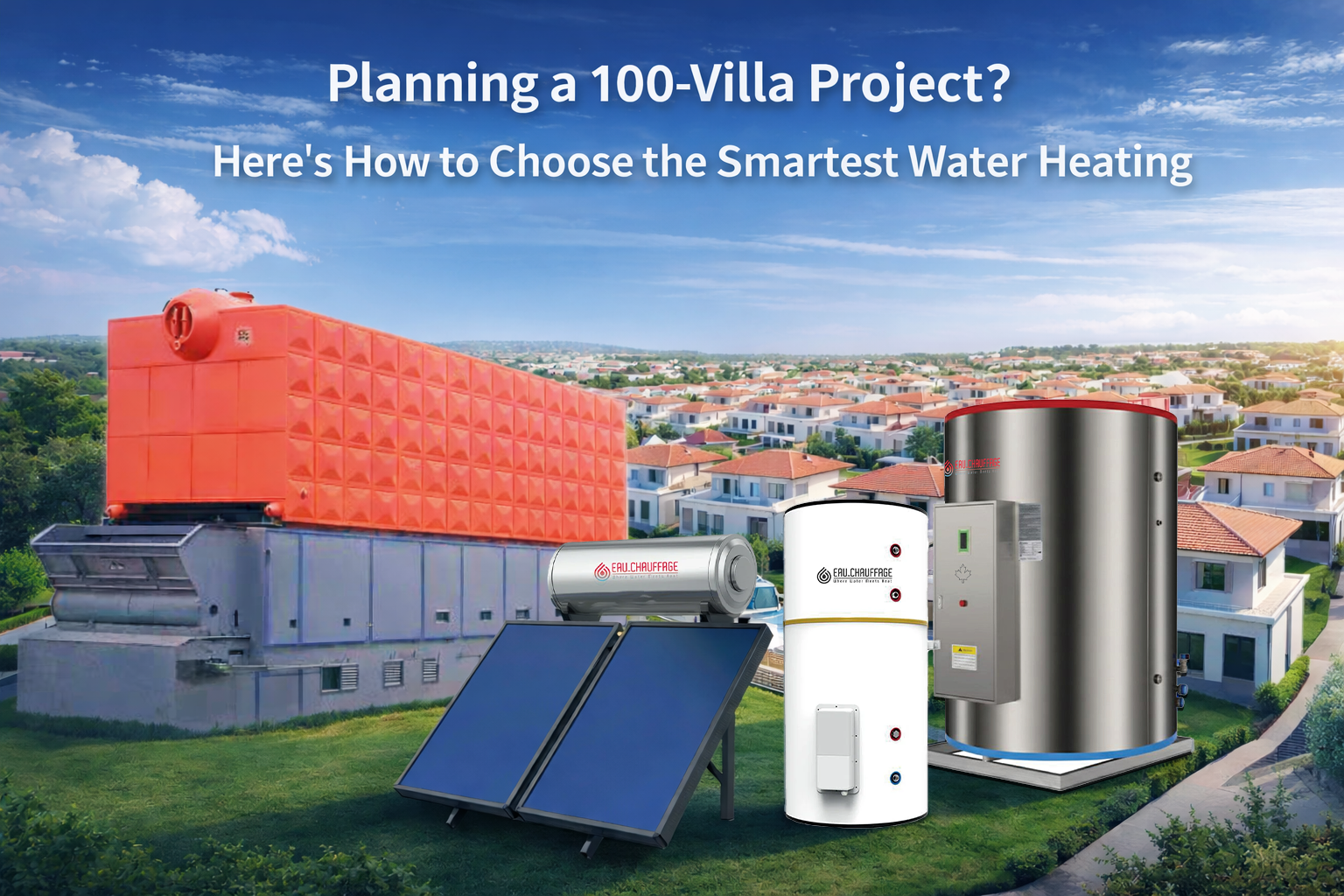
Specifying hot water for one villa is a technical decision. Specifying it for a hundred is a commercial one. The same equipment choice repeated across a development multiplies not only capital cost but installation labour, spare parts, warranty exposure and every future service call.
This guide is written for developers, contractors and consultants specifying at scale, where decisions that seem minor per unit become significant across a project.
The First Decision: Per-Unit or Central
Most villa developments give each unit its own system, and for good reason: metering is clean, each owner controls and pays for their own consumption, and a fault affects one household rather than the development.
Central plant serving multiple units can be more efficient per litre and consolidates maintenance, but it introduces billing complexity, distribution losses across the site, and shared liability that owners’ associations often resist.
| Factor | Per-unit systems | Central plant |
|---|---|---|
| Metering and billing | Simple, per owner | Requires allocation |
| Failure impact | One household | Multiple households |
| Distribution losses | Minimal | Grows with site size |
| Maintenance | Many units, owner responsibility | Consolidated, managed |
| Capital efficiency | Lower per litre | Higher per litre |
For most villa developments, per-unit systems win on practicality. Central plant becomes compelling for staff accommodation, serviced apartments and compounds under single management, where billing and maintenance are already centralised.
Standardise Ruthlessly
The most valuable decision available on a multi-unit project is limiting how many distinct models you install.
Every additional model means another spare part to stock, another installation procedure for crews to learn, another set of documentation, and another variable when a fault is diagnosed years later. Two or three well-chosen capacities covering all villa types will serve a development better than a catalogue of unit-specific optimisations.
Standardisation also strengthens your commercial position. Consolidated volume against a small number of models produces better pricing and a more reliable supply schedule than fragmented orders.
Size on Peak Hour, Per Villa Type
Size each villa type on its peak-hour demand rather than daily consumption. A four-bedroom villa where the family leaves within a forty-minute window needs materially more stored volume, or faster recovery, than one with the same occupancy spreading usage across the evening.
| Villa type | Typical starting capacity |
|---|---|
| 2 bedrooms, 2 bathrooms | 150-200 L |
| 3-4 bedrooms, 3 bathrooms | 300-500 L |
| 5+ bedrooms, 4+ bathrooms | 500 L and above |
| Staff quarters within the plot | Separate compact unit |
Note that recovery rate matters as much as capacity where demand is compressed. A large tank that refills slowly still runs cold during a concentrated morning peak.
Maintenance Liability Is a Design Decision
On a large development, installation position determines how much maintenance actually happens, and therefore how many warranty claims you receive.
A unit sealed above a finished ceiling with insufficient clearance to withdraw the anode rod will not be maintained. The anode will deplete, the tank will corrode, and the failure will arrive as a complaint against the developer or contractor rather than as routine owner maintenance.
Before finalising positions, confirm clearance for anode removal, access to the drain point and reachability of the pressure relief valve. This costs nothing at design stage and prevents a recurring category of callback.
Water Quality Changes the Specification
Hard groundwater deposits scale; desalinated supply behaves aggressively toward unprotected steel. Both shorten tank life, and both should influence which lining you specify and what maintenance interval you communicate to owners.
Establish the site’s water conditions before finalising the specification. On a hundred-villa project, an unsuitable tank choice multiplies into a hundred early failures, all of them arriving within the same period.
Solar at Development Scale
Villa developments are unusually well suited to solar. Each unit has its own roof, demand is steady and residential, and in high-irradiance regions a correctly sized system carries a substantial majority of annual hot water demand.
Two specification points matter at scale. Systems should be pressurised, because gravity-fed solar produces weak flow at upper-floor taps and generates owner complaints in two and three storey villas. And every installation needs backup, so hot water is guaranteed regardless of weather. See our villa solar water heaters, manufactured from 500 litres upward.
Solar also has a marketing dimension developers frequently underuse: lower running costs are a tangible selling point to buyers comparing otherwise similar properties.
Procurement and Programme
- Confirm production lead times against your handover programme before committing, particularly for larger or configured capacities.
- Plan phased delivery so units arrive as villas reach installation stage rather than sitting on site.
- Agree spare part provision up front, especially anode rods and thermostats.
- Request full technical documentation for consultant review and handover packs.
- Clarify warranty terms, including what maintenance owners must perform to keep cover valid.
That last point is worth writing into the owner handover pack. A warranty conditional on anode maintenance is only meaningful if owners were told.
Frequently Asked Questions
Per-villa or central plant for a compound?
Per-villa for sold units where owners meter and maintain independently. Central plant for developments under single management, such as staff accommodation or serviced apartments.
How many capacities should we standardise on?
Usually two or three across all villa types. Fewer models reduce spares, simplify installation and improve pricing, and the efficiency lost by not optimising each unit is minor.
Is solar worth it across a whole development?
In high-irradiance regions, generally yes, particularly where running cost is a selling point. Specify pressurised systems with backup, and confirm roof orientation per villa type at design stage.
Costs That Only Appear at Scale
Per-unit thinking hides several costs that become significant across a development.
| Hidden cost | How it multiplies |
|---|---|
| Installation labour variation | Every extra model means crews relearn the procedure |
| Spare parts inventory | Each model requires its own anode, thermostat and valve stock |
| Warranty administration | Mixed models complicate claims and documentation |
| Callbacks from poor access | One bad mounting decision repeats across every villa |
| Early failures from water quality | An unsuitable tank fails development-wide at once |
Notice that four of the five are decided at design stage and cost nothing to avoid there. Once villas are built, each becomes expensive to correct and impossible to correct quietly.
What to Hand Over to Owners
A short, clear handover reduces callbacks more reliably than any warranty clause, because most early complaints stem from owners not knowing what the system requires.
- The model, capacity and location of the unit, with a photograph of the access point
- What maintenance is required, particularly anode inspection, and at what interval for local water conditions
- Which maintenance is a condition of warranty cover
- How to isolate power and water in an emergency
- The warning signs that warrant a service call rather than waiting
Developments that provide this see materially fewer first-year complaints, because owners identify genuine faults early and stop reporting normal behaviour as defects.
A Short Specification Checklist for Developments
- Per-unit or central decided against ownership and billing structure, not only efficiency
- Capacities standardised to two or three models across all villa types
- Each type sized on peak-hour demand, with recovery rate checked separately
- Site water conditions established before selecting tank construction
- Mounting positions confirmed to allow anode removal, draining and valve testing
- Solar specified as pressurised, with backup, where roof orientation supports it
- Lead times aligned to the handover programme, with phased delivery agreed
- Spare parts provision and warranty maintenance conditions agreed in writing
- Owner handover pack prepared, including maintenance intervals and warning signs
Every line here is settled at design or procurement stage, where it costs nothing. After handover, each one becomes a callback, a warranty claim or a reputation issue, and all three arrive at once because a development fails on the same schedule it was built on.
Talk to Us About Your Project
Send us your villa types, bathroom counts, expected occupancy, site water conditions and programme, and our engineers will propose a standardised specification with capacities, recovery rates and, where relevant, solar integration. Email sales@eauchauffage.com or call +1 (905) 299-3382. See also our central water heating systems.
For clubhouses, staff accommodation and shared facilities within a development, see our commercial hot water systems guide.