








Industrial Boiler Fuel Comparison: Gas, Oil, Coal, Biomass

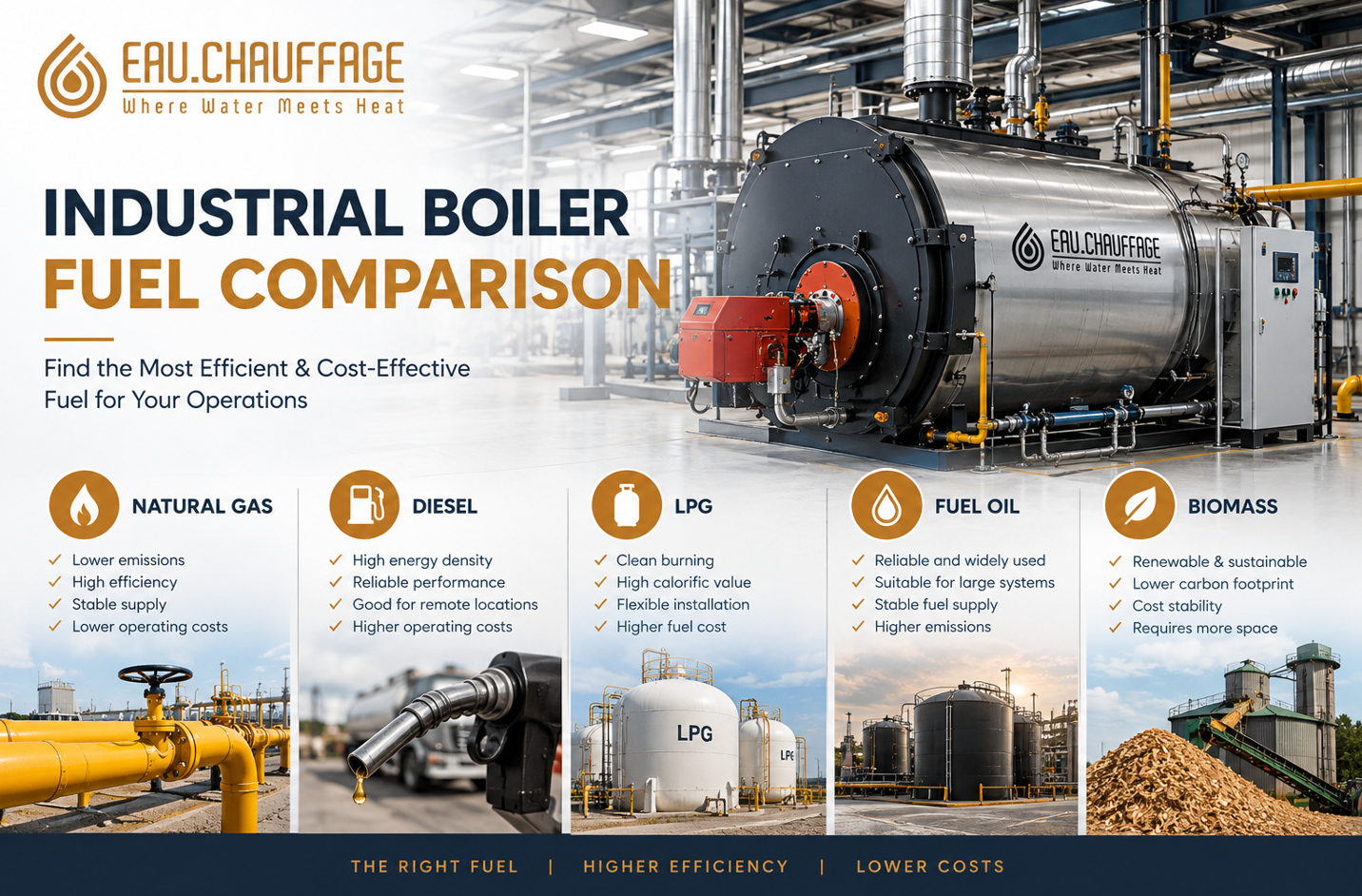
Over the life of an industrial boiler, the fuel costs far more than the boiler. A steam plant running two shifts will typically burn its own purchase price in fuel within its first year or two, and keep doing so for twenty years after that. Of all the decisions in a boiler specification, fuel is the one that is hardest to reverse and most expensive to get wrong.
It is also the decision most often made on a single number: the price per tonne or per litre. That number on its own is close to meaningless. This guide sets out how fuels are compared properly, what each one really costs to burn once handling, storage, ash and labour are counted, and where each one makes sense. It expands the short fuel table on our industrial steam boilers page into the full comparison.
The Only Fair Comparison: Cost per Useful kWh
Fuels are sold in different units, carry different amounts of energy, and burn at different efficiencies. To compare them you have to bring all three back to a single figure, the cost of one kilowatt-hour of heat actually delivered into the water or steam:
Cost per useful kWh = fuel price per unit ÷ (energy per unit in kWh × boiler efficiency)
A fuel that is half the price per tonne but carries half the energy and burns less efficiently is not cheaper. It is more expensive, and it also needs twice the trucks, twice the storage and more labour. The table below gives the typical figures you need for the calculation.
| Fuel | Typical net energy content | Typical boiler efficiency |
|---|---|---|
| Natural gas | about 9.5 to 10 kWh per Nm³ | 88 to 92% |
| LPG | about 12.8 kWh per kg | 88 to 92% |
| Diesel (light fuel oil) | about 10 kWh per litre | 86 to 90% |
| Heavy fuel oil | about 11 kWh per kg | 83 to 88% |
| Bituminous coal | about 5.5 to 7.8 kWh per kg | 75 to 82% |
| Wood chips (30 to 40% moisture) | about 2.8 to 3.6 kWh per kg | 75 to 85% |
| Wood pellets (under 10% moisture) | about 4.7 kWh per kg | 85 to 90% |
| Electricity | 1 kWh per kWh | 98 to 99% |
These are typical ranges, not guarantees. Solid fuels in particular vary widely from one supplier and one delivery to the next, so for a real calculation use the calorific value on your supplier’s analysis certificate, and ask for it on a net (lower heating value) basis so it matches boiler efficiency figures.
One Plant, Six Fuels: A Worked Comparison
Abstract figures are hard to act on, so here is a single plant worked through for every fuel. It is a 2 t/h steam plant at 10 bar(g) with feedwater at 80 °C, averaging 60 percent of full output across 6,000 operating hours a year. That is roughly 1,360 kW at full load and about 4,900 MWh of useful heat per year, a realistic profile for a food, textile or packaging plant.
| Fuel | Efficiency used | Fuel energy burned per year | Fuel quantity per year |
|---|---|---|---|
| Natural gas | 90% | 5,440 MWh | about 555,000 Nm³ |
| Diesel | 88% | 5,560 MWh | about 556,000 litres |
| Bituminous coal | 78% | 6,270 MWh | about 940 tonnes |
| Wood chips | 80% | 6,120 MWh | about 1,910 tonnes |
| Wood pellets | 87% | 5,620 MWh | about 1,200 tonnes |
| Electricity | 99% | 4,940 MWh | 4,940 MWh, with about 1.4 MW of connection |
To turn this into money, multiply each quantity by your local delivered price. We deliberately do not publish prices here: fuel prices differ several-fold between countries and move from month to month, and a figure printed today would mislead you by next quarter. The quantities, on the other hand, are physics, and they are what decide everything that follows in this guide.
Notice the spread in fuel energy burned: from 4,940 MWh for electricity to 6,270 MWh for coal, for exactly the same useful heat. That gap of more than a quarter is lost up the chimney and in the ash, and it is paid for whether or not anyone notices it.
What the Quantities Mean on Site
The worked example looks very different once it is converted into deliveries, storage and waste. This is where solid fuels reveal costs that never appear in a price per tonne.
| Fuel | Deliveries per year | Two weeks of storage | Ash to dispose of per year |
|---|---|---|---|
| Natural gas (pipeline) | None | None | None |
| Diesel | about 19 tankers of 30,000 litres | about 21,000 litres of bunded tank | None |
| Coal | about 38 trucks of 25 tonnes | about 36 tonnes on a covered yard | roughly 90 to 190 tonnes |
| Wood chips | about 87 trucks of 22 tonnes | about 75 tonnes, roughly 250 m³ | roughly 20 to 60 tonnes |
| Wood pellets | about 48 trucks of 25 tonnes | about 46 tonnes in a silo | under about 12 tonnes |
Wood chips need more than twice the deliveries of coal and several times its storage volume, because they are both lower in energy and much less dense. Coal produces the most ash by far, typically 10 to 20 percent of what is burned, and that ash has to be collected, stored and legally disposed of. None of this shows up in a fuel quotation, and all of it shows up in the operating budget.
Natural Gas: The Default Where the Pipe Exists
Where a gas main reaches the site at a reasonable tariff, gas is usually the answer, and not only because of its price. It arrives continuously with no deliveries or storage, burns cleanly with no ash, and a modulating burner can follow the process load closely instead of cycling on and off. Maintenance is the lightest of any combustion fuel and a gas plant needs the least operator attention.
Gas also emits the least carbon dioxide of the fossil fuels per unit of heat, and low-NOx burners are available where local rules on nitrogen oxides are strict. Our WNS, LSS, SZS and SM series are built around gas and oil firing, including condensing and low-nitrogen versions.
The limits are availability and contract terms. Where there is no pipeline, LPG or LNG can be trucked in, but that brings back storage and deliveries and usually a higher price per kWh. And where industrial gas is allocated rather than freely bought, the allocation, not the tariff, can be the deciding factor.
Diesel and Heavy Fuel Oil: Portable Energy at a Price
Oil is the fuel of sites without gas. Diesel is simple to store and burn, needs no preheating, and a boiler firing it is almost as easy to automate as a gas boiler. It is also the natural backup fuel: a dual-fuel burner running on gas with diesel standby lets a plant ride through a gas interruption without stopping production, a sensible arrangement anywhere supply is less than certain.
Heavy fuel oil is cheaper per kWh in some markets but is harder work. It must be heated to be pumped and atomised, it leaves more deposits on heat transfer surfaces, and it carries more sulphur, which brings emissions limits and corrosion risk in the flue. It suits large, continuously running plants with the staff to look after it, rather than smaller sites.
With oil, the storage tank and its bunding are part of the installation, and the fuel supply contract deserves as much attention as the boiler, since a missed delivery is a stopped plant.
Coal: Cheap Energy, Expensive Handling
In regions where coal is mined locally and sold cheaply, it can still offer the lowest fuel price per kWh, and that is the reason chain-grate coal boilers such as our DZL and SZL series remain in wide use. They are rugged, tolerant machines built to run around the clock with an automatic grate feeding fuel and discharging ash.
The honest picture, though, has to include everything around the boiler: a covered fuel yard, conveyors or hoppers, ash handling and disposal, dust control, and flue gas treatment to meet particulate and sulphur dioxide limits. Coal boilers respond more slowly to load changes than gas or oil, and they need more operator attention. When these costs are added, a low price per tonne can shrink considerably.
Coal also carries the highest carbon dioxide emissions of any common boiler fuel, which matters more every year as carbon pricing and customer reporting spread. We build and supply coal-fired boilers because for some sites they remain the economical option, but we do not present them as a clean choice. Where emissions rules are tightening, it is worth checking that a coal plant will still be permitted, and affordable to run, a decade from now.
Biomass: Renewable, but Only as Good as the Fuel
Biomass boilers, such as our DZH series, burn wood chips, pellets and agricultural residues. Where a steady local supply exists, from sawmills, forestry or crop processing, biomass can be both economical and near carbon-neutral, because the carbon released was recently absorbed by the plants it came from. That claim holds only when the fuel is sourced sustainably, and it is worth being able to show where yours comes from.
The defining issue with biomass is moisture. Water in the fuel has to be evaporated before any useful heat is released, so the same wood delivers very different energy depending on how wet it is:
| Moisture content of wood | Typical net energy | Energy compared with dry pellets |
|---|---|---|
| About 10% (pellets) | about 4.7 kWh per kg | 100% |
| About 30% (seasoned chips) | about 3.4 kWh per kg | roughly 70% |
| About 50% (fresh chips) | about 2.2 kWh per kg | under half |
Buying wood by the tonne without specifying moisture is therefore buying water at fuel prices. A good biomass contract states the moisture range and adjusts the price for it, and a good biomass plant is designed for the fuel it will actually receive, since a grate set up for dry pellets will struggle with wet chips.
Biomass also needs the largest storage, the most deliveries and a reliable supply chain. Agricultural residues such as husks and shells can be excellent fuels when available in volume, but their ash behaves differently from wood ash and must be considered in the grate and cleaning design.
Electric Boilers: Simple, Clean on Site, Rarely Cheapest
An electric boiler, such as our WDR series, converts almost all of the electricity it uses into heat, with no flue, no combustion, no fuel storage and no emissions at the site. It is compact and quiet and needs little maintenance, which makes it the right answer for clean rooms, laboratories, buildings where a chimney is not permitted, and small or intermittent loads.
For larger continuous loads, two things usually rule it out. Electricity is generally the most expensive energy per kWh, and the plant in our worked example would need about 1.4 MW of electrical connection, which many sites simply do not have. The exceptions are sites with cheap or surplus power, and they are worth checking carefully, because where they exist electric steam can be very attractive.
Whether electric heat is low in carbon depends entirely on how the grid generates it, a point we set out in more detail in our comparison of electric and gas water heaters.
Carbon Dioxide per Unit of Heat
Emissions are becoming a cost in their own right, through carbon pricing, permits and the reporting demanded by larger customers. For the worked example above, using standard emission factors for each fuel:
| Fuel | CO₂ per kWh of fuel burned | CO₂ per year in the worked example |
|---|---|---|
| Natural gas | about 0.20 kg | about 1,100 tonnes |
| Diesel | about 0.27 kg | about 1,480 tonnes |
| Bituminous coal | about 0.34 kg | about 2,130 tonnes |
| Sustainable biomass | treated as near zero | near zero, plus transport |
| Electricity | depends on the grid | from near zero to above coal |
The same plant emits roughly twice as much carbon dioxide on coal as on gas. If your market is introducing a carbon price, multiply the difference by that price and add it to the fuel comparison: it can change the answer on its own.
The Costs That Never Appear in a Fuel Quote
| Cost | Gas | Oil | Coal | Biomass | Electric |
|---|---|---|---|---|---|
| Fuel storage and handling | None | Tank and bund | Yard, conveyors | Large store, feed system | None |
| Ash handling and disposal | None | None | Significant | Moderate | None |
| Flue gas treatment | Low | Moderate | Significant | Moderate (dust) | None |
| Operator attention | Low | Low to moderate | Significant | Moderate to high | Lowest |
| Response to load changes | Fast | Fast | Slow | Slow to moderate | Fast |
| Plant room footprint | Smallest | Small plus tank | Largest | Large | Smallest |
Response to load changes deserves a word of its own. A process with frequent swings in steam demand, batch cookers or sterilisers for example, is well served by gas or oil, which can modulate in seconds. A solid-fuel grate holds a large mass of burning fuel and cannot change output quickly, so it is better suited to steady, continuous loads. Our guide to steam, hot water and thermal oil covers the equivalent choice for the heat transfer medium.
A Note for the Gulf and Wider Region
Across the Gulf, the practical choice for most industrial plants is between gas and diesel. Where a site has a gas connection and allocation, gas is normally the most economical and simplest option; where it does not, diesel is the usual fuel, and a dual-fuel burner is a sensible safeguard wherever gas supply might be interrupted. Solid fuels are rarely the economical choice in the region, since liquid and gaseous fuels are produced locally, while biomass depends on a steady local residue stream that few sites have. Elsewhere in our markets, in parts of Asia and Africa, coal and biomass remain common and the comparison in this guide becomes much closer. Local conditions for Saudi projects are covered on our water heaters in Saudi Arabia page.
How to Decide: A Short Checklist
- What is reliably available at the site, for twenty years rather than this year? A cheap fuel you cannot always get is not cheap.
- What is the delivered cost per useful kWh, calculated with the formula above and your real quotes?
- What does the fuel need around the boiler: storage, handling, ash, flue treatment and staff?
- How steady is the load? Swinging loads favour gas and oil; steady loads suit solid fuels.
- What are the emissions rules now and likely to be later, and is there a carbon price to include?
- Is a second fuel needed as backup, and can the burner be dual-fuel from the start?
Frequently Asked Questions
Which industrial boiler fuel is cheapest?
There is no universal answer, because fuel prices differ several-fold between countries. Compare fuels on cost per useful kWh: price per unit divided by energy per unit times boiler efficiency, then add the storage, ash and labour costs that come with each fuel.
Is a gas boiler more efficient than a coal boiler?
Generally yes. Gas boilers typically reach 88 to 92 percent efficiency, while chain-grate coal boilers typically run at 75 to 82 percent, losing more heat in the flue gas and in unburned fuel in the ash.
Can a coal boiler burn biomass?
Some grate boilers can be converted or co-fire biomass, but it is not a simple swap. Biomass is lighter, wetter and lower in energy, so it needs a different feed system, more storage and grate settings suited to its moisture and ash. Treat it as an engineering project rather than a change of supplier.
Is biomass really carbon-neutral?
Its combustion carbon is usually counted as near zero when the fuel comes from sustainably managed sources or genuine residues, because that carbon was recently absorbed by growing plants. Transport and processing still carry emissions, and poorly sourced biomass does not earn the claim.
Should I choose a dual-fuel burner?
If your process cannot stop and your main fuel supply can be interrupted, yes. Gas with diesel standby is the most common arrangement and adds modest cost compared with the price of a production stoppage.
When does an electric steam boiler make sense?
For small or intermittent loads, clean environments, buildings without a flue, and sites with cheap or surplus electricity. For large continuous loads, the running cost and the size of the electrical connection usually rule it out.
Get a Fuel Comparison for Your Plant
Send us your steam or heat demand, operating hours, the fuels available to you and their delivered prices, and our engineers will run the comparison for your site and recommend a boiler to match, from our oil and gas, coal, biomass and electric series.
Pressure vessels are engineered to ASME requirements and every unit is manufactured under a certified ISO 9001:2015 quality management system. Email sales@eauchauffage.com or call +1 (905) 299-3382. Browse the full steam boiler range and the wider industrial range.