







Boiler Feedwater Treatment: Why Scale Kills Efficiency

Most boilers do not fail suddenly. They lose efficiency quietly, a fraction of a percent at a time, as a thin layer of mineral builds up on the water side of the heating surfaces. Nobody sees it, the steam keeps coming, and the only symptom is a fuel bill that creeps upward and a flue that runs a little hotter every month. By the time a tube bulges or a furnace cracks, the damage was done years earlier.
That layer is scale, and preventing it is the job of feedwater treatment. This guide explains what scale is and why it forms, what it really costs in fuel and in boiler life, how a treatment system is built step by step, and how to tell when yours is not working. It expands the short section on water quality on our industrial steam boilers page.
What Scale Is and Why It Forms
All natural water carries dissolved minerals. The ones that matter most in a boiler are the hardness salts, calcium and magnesium, together with silica. Two things push them out of solution and onto the metal.
The first is temperature. Unlike most substances, calcium carbonate and calcium sulphate become less soluble as water gets hotter, so they come out of solution precisely where the water is hottest: on the tube and furnace surfaces where heat enters.
The second is concentration. A boiler turns water into steam, and steam leaves almost pure, carrying none of the minerals with it. Everything that came in with the feedwater stays behind. Hour after hour the boiler water becomes more concentrated, until the minerals can no longer stay dissolved and deposit as a hard, stone-like layer.
| Deposit | Where it comes from | Why it matters |
|---|---|---|
| Calcium carbonate | Hard water with carbonate alkalinity | The most common scale; relatively soft but insulating |
| Calcium and magnesium sulphate | Hard water rich in sulphates | Harder and more adherent, difficult to remove |
| Silica and silicates | Groundwater and some surface waters | Glassy and highly insulating; very hard to clean off |
| Iron oxides | Corrosion in the feed system and condensate lines | Evidence of corrosion elsewhere; adds to deposits |
The First Cost: Fuel
Steel conducts heat well. Scale conducts it poorly, many times worse than steel, and silica-rich scale is worse again. A layer of scale sits between the flame and the water like a blanket, so less of the heat reaches the water and more of it leaves up the chimney.
Widely used industry figures, such as those in energy agency steam tip sheets, put the loss at roughly 1 to 2 percent of fuel for each 0.4 to 0.8 mm of ordinary carbonate scale, and several times more for scale containing iron or silica. Those figures are approximate, because real deposits vary, but the direction is never in doubt: scale always costs fuel, and the loss grows with every millimetre.
To put a number on it, take the 2 t/h gas-fired plant from our industrial boiler fuel comparison, which burns about 5,440 MWh of gas a year:
| Efficiency lost to scale | Extra fuel per year | Extra natural gas per year |
|---|---|---|
| 2% (thin carbonate scale) | about 110 MWh | about 11,000 Nm³ |
| 5% (heavier or silica-rich scale) | about 270 MWh | about 28,000 Nm³ |
That fuel is burned every year the scale is left in place, on top of everything the plant needed anyway. In most plants it is far more than the annual cost of a softener and its salt.
The Second Cost: Overheated Metal
Fuel is the cost you pay slowly. Metal damage is the cost you pay all at once.
A boiler tube or furnace survives the heat of the flame only because water on the other side carries the heat away as fast as it arrives. The metal stays close to the water temperature. Put a layer of scale between the metal and the water and that cooling is interrupted: the heat still arrives, but it cannot leave as easily, so the metal runs hotter.
Steel loses strength as its temperature rises. A tube that was comfortably strong at its design temperature can become weak enough to bulge, blister or crack under the same pressure once it runs substantially hotter. In fire-tube boilers the furnace tube, which takes the most intense heat, is usually the first to suffer. These failures are expensive to repair, stop production, and in the worst cases are dangerous, which is why pressure vessels are inspected and why water treatment is a condition of safe operation, not an optional extra.
The Other Enemy: Dissolved Oxygen
Scale is only half of the problem. Water also carries dissolved oxygen and carbon dioxide, and neither causes scale. Instead, they cause corrosion.
Oxygen attacks steel as localised pitting: small, deep holes rather than an even loss of metal, which is why a boiler can look sound and still leak. Carbon dioxide leaves the boiler with the steam, dissolves in the condensate as carbonic acid and eats through condensate return pipes. The iron that corrosion removes then travels back to the boiler and adds to the deposits. A good treatment programme deals with both scale and corrosion together.
How a Treatment System Is Built
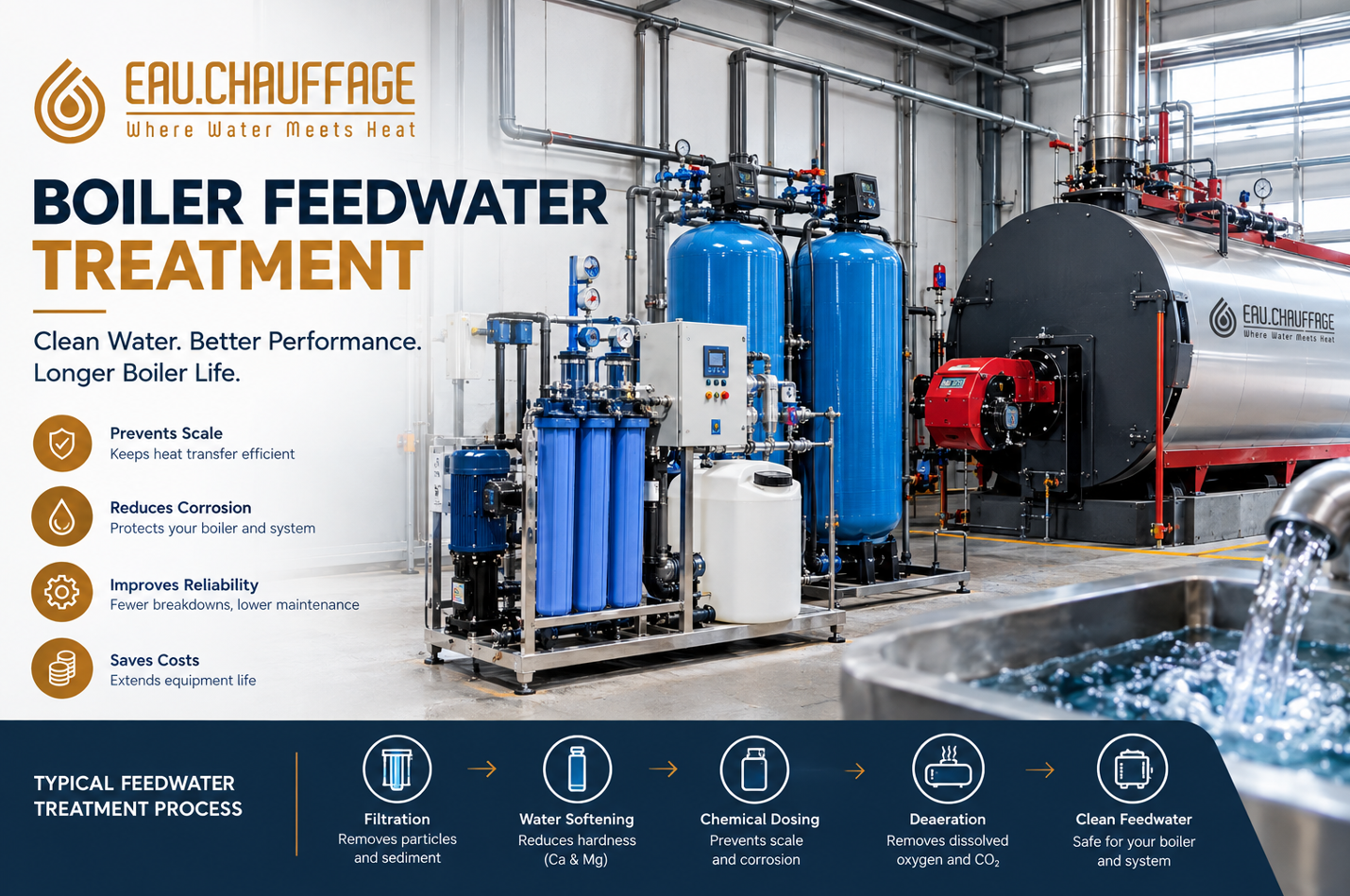
Feedwater treatment is a chain, and each link removes a different problem. Not every plant needs every link, but every plant needs to know which ones it has left out and why.
1. Filtration
Removes suspended solids, sand and silt before they reach the softener or membranes. Cheap, simple and the foundation of everything downstream.
2. Softening
An ion-exchange softener swaps calcium and magnesium for sodium, which stays dissolved at boiler temperatures and does not form scale. It is the single most important step for most plants and the minimum for any steam boiler on hard water. Note what it does not do: softening does not reduce the total amount of dissolved solids, and it does not remove silica.
3. Reverse osmosis, where the water demands it
Reverse osmosis pushes water through a membrane that holds back most dissolved salts, including silica. Where make-up water is high in total dissolved solids or silica, it transforms the economics of the boiler, as the blowdown example below shows. It is not free: a membrane plant rejects part of its feed as concentrate, uses electricity and needs softened or conditioned water ahead of it to protect the membranes.
4. Deaeration
Hot water holds less gas than cold. A feed tank kept at around 85 to 90 °C drives off much of the oxygen, and a pressurised deaerator, which heats the water to boiling with steam, removes almost all of it. Smaller plants often combine a hot feed tank with a chemical oxygen scavenger to remove what remains.
5. Internal chemical conditioning
Chemicals dosed into the feedwater hold the boiler water at the right alkalinity, turn any residual hardness into a soft sludge that can be blown down rather than baked on as scale, and keep that sludge dispersed. Where condensate is returned, neutralising amines protect the return lines from carbonic acid. In food and pharmaceutical plants where steam touches the product, chemical selection is restricted and must be agreed with your treatment supplier.
6. Blowdown
However good the treatment, the dissolved solids that enter with the feedwater stay in the boiler. Blowdown removes a controlled amount of concentrated boiler water to hold the concentration below the limit. Continuous or automatic blowdown controls total dissolved solids; short bottom blowdowns remove the sludge that settles in the lowest part of the boiler.
Blowdown: The Cost of Dirty Feedwater, in Numbers
Blowdown is where feedwater quality turns directly into money, because every kilogram blown down is water that was treated, heated to boiler temperature and then thrown away. The amount needed follows a simple rule:
Blowdown as a share of steam = feedwater TDS ÷ (boiler water TDS limit − feedwater TDS)
Here is the same 2 t/h plant, averaging 1,200 kg/h of steam at 10 bar(g) over 6,000 hours a year, with a boiler water limit of 3,000 mg/L, first on softened water and then on reverse osmosis water:
| Softened feedwater (TDS 250 mg/L) | Reverse osmosis feedwater (TDS 20 mg/L) | |
|---|---|---|
| Blowdown as share of steam | about 9% | under 1% |
| Blowdown flow | about 110 kg/h | about 8 kg/h |
| Hot water discarded per year | about 650 m³ | about 50 m³ |
| Heat discarded per year | about 123 MWh | about 9 MWh |
| Gas burned to replace it | about 14,000 Nm³ | about 1,000 Nm³ |
Blowdown water leaves at boiler temperature, about 184 °C at 10 bar(g), so each kilogram carries away several times the heat of the cold water that replaces it. That is why cleaner feedwater pays twice: less blowdown means less water and chemicals, and less heat thrown away. On a large plant, a flash vessel and heat exchanger can also recover much of the heat from the blowdown that remains.
The comparison is not the whole economics of reverse osmosis, since the membrane plant has its own running costs and reject water. But it shows why high-TDS water sources make reverse osmosis worth pricing, and why returning clean condensate, which is almost free of dissolved solids, is one of the best investments in any steam system.
Typical Water Quality Targets
Exact limits depend on boiler type, pressure and the manufacturer’s documentation, which always takes precedence. As a general guide for shell (fire-tube) steam boilers:
| Parameter | Typical target | Why |
|---|---|---|
| Feedwater total hardness | As close to zero as practical, typically below about 2 mg/L as CaCO₃ | Hardness is the raw material of scale |
| Feedwater dissolved oxygen | As low as practical after deaeration and scavenging | Oxygen causes pitting corrosion |
| Feedwater pH | Around 8.5 to 9.5 | Protects the feed system from corrosion |
| Boiler water pH | Around 10.5 to 12 | Alkaline water protects boiler steel |
| Boiler water TDS | Below the manufacturer’s limit, often 2,000 to 3,500 mg/L | Above it, foaming and carryover begin |
| Boiler water silica | Within the limit for the operating pressure | Limits tighten as pressure rises |
Hot water boilers in closed circuits are more forgiving, because the same water circulates and little fresh water enters. The risk there is repeated topping up to replace leaks, which brings in fresh hardness and oxygen every time.
Water in the Gulf: Two Opposite Problems
Plants across the Gulf often face one of two very different source waters, and they need different treatment.
- Groundwater is frequently hard and high in dissolved solids and silica. Softening alone leaves the total dissolved solids high, so blowdown stays heavy, and it leaves the silica untouched. Reverse osmosis is often justified.
- Desalinated water is low in hardness but also low in the natural alkalinity that buffers corrosion, so it can be aggressive towards steel if it is not conditioned. Here the emphasis moves from scale control to pH control and deaeration.
Many sites draw on both sources at different times, so the only reliable basis for design is a proper analysis of the water you will actually use. How water conditions affect the choice between steam, hot water and thermal oil is covered in our guide to steam vs hot water vs thermal oil, and wider local conditions on our water heaters in Saudi Arabia page.
Signs Your Water Treatment Is Failing
- Flue gas temperature rising at the same load. Heat that no longer reaches the water leaves in the flue; a steady upward trend is the classic early sign of fouling.
- Fuel per tonne of steam increasing with no change in production.
- Softener regenerating late or not at all, or hardness appearing in the softened water test.
- Foaming, priming or wet steam, often caused by boiler water TDS running too high.
- Discoloured or rusty condensate, a sign of corrosion in the return system.
- Frequent low-water alarms or level instability, which can accompany foaming.
- Visible scale or pitting at inspection, which means the damage has already begun.
A Simple Testing Routine
| Test | How often | What it tells you |
|---|---|---|
| Softened water hardness | Daily, or every shift on large plants | Whether the softener is doing its job |
| Boiler water TDS or conductivity | Daily | Whether blowdown is set correctly |
| Boiler water pH and alkalinity | Daily to weekly | Whether chemical dosing is right |
| Chemical reserve (for example sulphite or phosphate) | Daily to weekly | Whether oxygen and hardness are being handled |
| Feed tank temperature | Every shift | Whether oxygen is being driven off |
| Condensate conductivity | Weekly, or continuously | Whether condensate is contaminated before it returns |
Record the results. A log turns single readings into trends, and it is the trend, not any one number, that shows a problem developing early enough to fix it cheaply.
If Scale Has Already Formed
Scale can be removed by chemical cleaning with inhibited acids or by mechanical means, depending on the deposit and the boiler. Either way it is specialist work: the wrong acid or the wrong procedure can damage the boiler more than the scale did, and cleaning without fixing the cause simply resets the clock. The sequence is always the same: identify the deposit, remove it safely, then correct the treatment so it does not return.
Frequently Asked Questions
Why is boiler water treatment necessary?
Because untreated water deposits scale, which wastes fuel and overheats metal, and carries oxygen, which corrodes steel. Treatment protects both the efficiency and the safety of the boiler, and it is usually a condition of the manufacturer’s warranty.
How much fuel does boiler scale waste?
Common industry figures put it at roughly 1 to 2 percent of fuel for each 0.4 to 0.8 mm of ordinary scale, and more for silica or iron-rich deposits. On a 2 t/h gas-fired plant, a 2 percent loss is about 11,000 Nm³ of gas a year.
Is a water softener enough for a steam boiler?
For many plants on moderately hard water, a softener with deaeration, chemical conditioning and correct blowdown is enough. Where the water is high in dissolved solids or silica, softening alone leaves blowdown high and silica untreated, and reverse osmosis is usually worth considering.
What is boiler blowdown?
The controlled removal of concentrated boiler water to keep dissolved solids below the limit, plus short bottom blowdowns to remove settled sludge. The cleaner the feedwater, the less blowdown is needed.
Why remove oxygen from feedwater?
Dissolved oxygen causes pitting corrosion, small deep holes that can perforate tubes and tanks while the surrounding metal still looks sound. Heating the feedwater and adding a scavenger removes it.
Does returning condensate really help?
Yes, in three ways. Condensate is hot, so it saves fuel; it is almost free of dissolved solids, so it reduces blowdown; and it is already treated, so it cuts water and chemical costs.
Water Treatment Engineered In, Not Added Later
Our steam systems are designed with water treatment, feedwater tanks and deaeration as part of the plant, and our skid-mounted packages arrive with them already configured. Send us a water analysis, or at least tell us where your water comes from, together with your steam demand and condensate return, and our engineers will specify the treatment chain to match.
Pressure vessels are engineered to ASME requirements and every unit is manufactured under a certified ISO 9001:2015 quality management system. Email sales@eauchauffage.com or call +1 (905) 299-3382. Browse the full steam boiler range.