











Before You Buy a Water Heater… 5 Critical Mistakes to Avoid

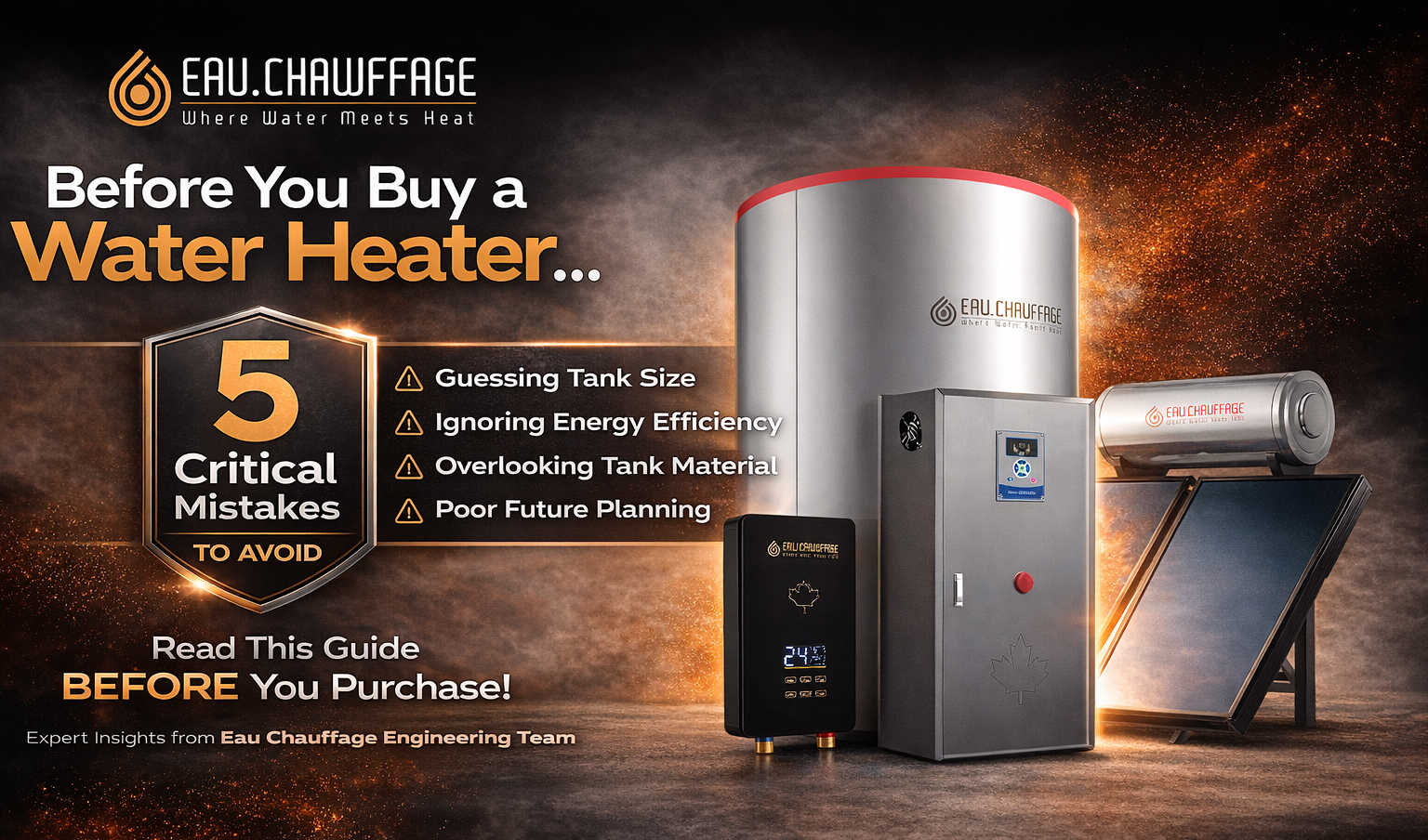
Most water heater regret is not caused by buying a bad product. It is caused by buying a reasonable product for the wrong situation. These five mistakes account for the large majority of complaints we hear, and every one of them is avoidable before you order.
Mistake 1: Sizing on Daily Use Instead of Peak Hour
The most common error, and the one that produces daily irritation. Buyers estimate total daily consumption, pick a matching capacity, then discover the tank runs cold halfway through the second shower.
Hot water demand is not spread evenly. It concentrates into short windows, usually morning and evening. A 40-room hotel and a 40-cover restaurant may consume similar daily volumes, yet the hotel compresses nearly all of it into ninety minutes and needs far more stored volume.
Avoid it: count what happens in your busiest hour, including overlapping outlets, and size for that.
Mistake 2: Ignoring Local Water Quality
Water heaters rarely fail because the element burns out. They fail because the tank corrodes and leaks, and how fast that happens depends heavily on what is in your water.
Hard groundwater deposits scale on hot surfaces, insulating the element and forcing longer run times. Desalinated supply behaves aggressively toward unprotected steel. Both shorten tank life, and both change which lining and which maintenance interval you should choose.
Avoid it: ask about local water conditions before choosing a tank, and shorten anode inspection intervals in hard water areas.
Mistake 3: Comparing on Capacity Alone
Two 100-litre heaters can differ enormously in what actually matters. One may have an enamel-coated tank, thick insulation and a proper safety package; the other may have a thin lining, minimal insulation and a single thermostat.
They hold the same water. They will not last the same time, cost the same to run, or fail the same way.
| Compare on | Not just on |
|---|---|
| Tank lining and material | Litres |
| Insulation thickness | Price |
| Power rating and recovery | Brand familiarity |
| Safety devices included | Control panel features |
Avoid it: request the specification sheet, not just the capacity and price.
Mistake 4: Forgetting the Anode Rod
Inside an enamel-lined tank sits a magnesium rod designed to corrode so the tank does not. It is consumable. Once fully depleted, corrosion moves on to the tank walls.
An anode costs a small fraction of a replacement heater, yet it is the single most neglected maintenance item in the industry. Many heaters described as “failed after a few years” simply ran with a consumed anode.
Avoid it: confirm the anode is accessible before installation, and inspect it periodically, more often in hard water.
Mistake 5: No Redundancy in Commercial Buildings
A single large unit is efficient right up to the moment it needs service. Then a hotel, clinic or labour accommodation has no hot water at all, which is not an inconvenience but an operational failure.
Cascading two smaller units instead of installing one large one preserves partial service during maintenance and protects against total loss. The capital difference is usually modest; the operational difference is not.
Avoid it: for any building where hot water interruption stops trading, specify redundancy from the start.
Warning Signs Your Current System Was Mis-Specified
- Hot water runs out during normal morning use
- Noticeably weak flow at upper-floor outlets
- The unit runs almost continuously rather than cycling
- Rumbling or knocking sounds, usually sediment on the element
- Rising bills without any change in household habits
- Water discolouration, often an early sign of internal corrosion
Frequently Asked Questions
Is it worth paying more for a better tank?
Usually yes, because the tank is the part that ends the machine’s life. Elements, thermostats and valves are replaceable; a perforated tank is not.
My hot water runs out. Do I need a bigger tank?
Not necessarily. It may be a recovery-rate problem rather than a capacity one, or sediment insulating the element. Check those before assuming you need more litres.
How do I know if my water is hard?
Visible scale on taps and kettles, soap that lathers poorly, and white deposits around outlets are practical indicators. Your local water authority can usually confirm.
Three More Mistakes Worth Avoiding
Choosing a location that makes maintenance impossible
A heater sealed above a finished ceiling or wedged into a tight cupboard may install neatly, but if the anode rod cannot be withdrawn and the tank cannot be drained, maintenance quietly stops happening. That converts a long-life product into a short-life one.
Before finalising position, check the clearance required to remove the anode. It is usually longer than people expect.
Ignoring recovery rate
Capacity and power rating are different specifications. Capacity tells you how much hot water is stored; power rating tells you how quickly it returns after the tank is drawn down.
Buildings with compressed demand, such as hotels or family homes with a short morning window, can have plenty of litres and still run cold, because the tank cannot refill fast enough between draws. If your demand is concentrated, recovery rate deserves as much attention as capacity.
Assuming solar removes the need for backup
Solar covers the base load extremely well, but weather varies and demand occasionally exceeds what the tank collected. A building that cannot guarantee hot water has a problem no matter how good the collectors are.
Every solar installation should include backup, either an electric element in the tank or a heat pump where shortfalls are frequent. Solar carries the load; backup guarantees supply.
A Short Pre-Purchase Checklist
- Sized on peak-hour demand, not daily consumption
- Local water conditions considered when choosing the tank
- Specification sheet reviewed, not just capacity and price
- Anode rod present, and accessible after installation
- Recovery rate matched to how concentrated your demand is
- Redundancy planned where interruption stops operations
- Backup included if the system is solar
- Drain point and relief valve reachable for testing
Most water heater disappointment traces back to one of these lines being skipped at the ordering stage, when correcting it would have cost nothing.
Questions to Ask Before You Order
A short list of questions separates a considered purchase from a hopeful one. Any competent supplier can answer all of these without hesitation.
- What is the inner tank made of, and how is it protected? Enamel coating, stainless steel or bare steel changes the expected lifespan entirely.
- Is there an anode rod, and how do I access it? If the answer is vague, assume maintenance will be difficult.
- What is the power rating, and what recovery does that give? Capacity alone does not answer whether the system suits a compressed morning peak.
- What safety devices are included? Look for a thermostat plus an independent thermal cut-out, pressure relief and leakage protection, not just one of them.
- What clearance does installation require? Particularly for anode removal and draining.
- Is this suitable for our local water? A supplier who asks about your water before answering is a good sign.
If a quotation lists only capacity, price and a warranty period, you do not yet have enough information to compare it against anything.
The Underlying Pattern
Every mistake on this page shares a root cause: a decision made on the most visible number instead of the one that governs the outcome. Capacity is visible; recovery rate is not. Price is visible; tank lining is not. Warranty length is visible; whether the anode can be reached is not.
Water heating is unusually forgiving of a modest budget and unusually unforgiving of a careless specification. Getting the invisible details right at the ordering stage costs nothing and determines most of what happens over the following decade.
Specify It Right the First Time
Send us your building type, fixture count, occupancy pattern and local water conditions and our engineers will recommend capacity, recovery rate and tank construction together. Email sales@eauchauffage.com or call +1 (905) 299-3382.
Related: how to choose a water heater in 6 steps and our central water heating systems.
Sizing is where most of these mistakes begin. See what size water heater do I need for the peak-hour method with real figures.