











Restaurant & Commercial Kitchen Hot Water Systems: Sizing Guide

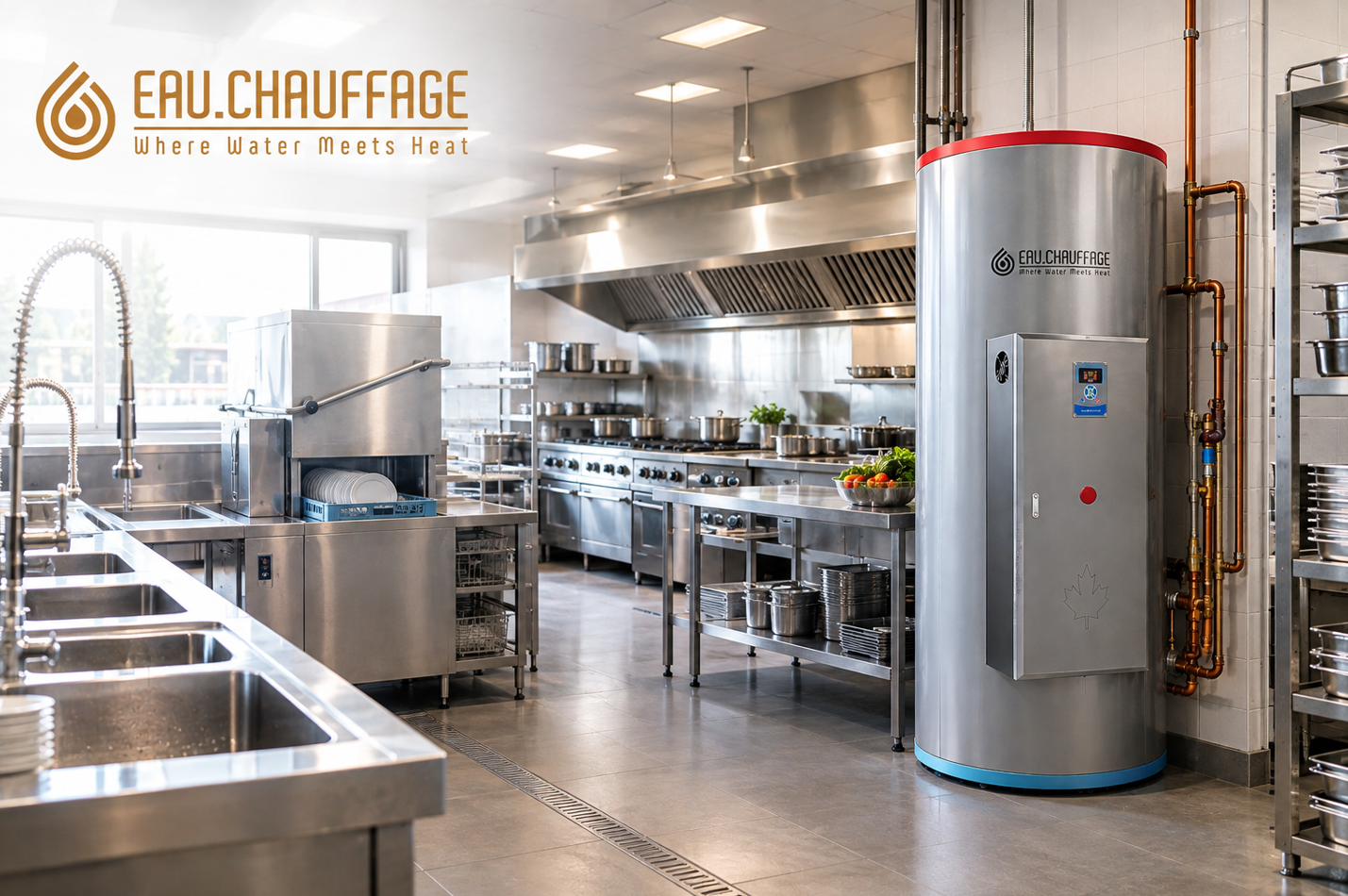
A restaurant does not run out of hot water the way a hotel does. There is no single ninety-minute rush and then quiet. Instead the kitchen draws hot water continuously for three or four hours at a stretch, twice a day, from equipment that will not wait: a dishwasher that stops sanitising when its rinse temperature drops, a pot sink that has to be refilled between courses, and a health inspector who checks the thermometer rather than the menu.
That difference changes how the system should be designed. Hotels are a storage problem. Commercial kitchens are a recovery problem, and sizing them on tank volume alone is the reason so many restaurants end a Friday service washing plates in lukewarm water.
This guide sets out how much hot water a kitchen actually uses, which temperatures each fixture needs, how to size storage and heating power for a sustained service, and where a booster heater belongs. It follows the general method in our guide to commercial hot water systems, applied to the one sector where the peak is long rather than sharp.
Three Temperatures, Not One
A kitchen is unusual in needing hot water at three distinct temperatures at the same time, and a system that delivers only one of them will be wrong somewhere.
| Use | Temperature at the point of use | Why |
|---|---|---|
| Hand-wash basins, food preparation | About 40 °C, never above 45 °C | Scald protection; staff will not wash properly in water that hurts |
| Pot sinks, pre-rinse, general cleaning | 55–60 °C | Cuts grease; the working temperature of most kitchen labour |
| Dishwasher wash cycle | 60–65 °C | Detergent performance and grease removal |
| Dishwasher final rinse (high-temperature machines) | About 82 °C | Thermal sanitising; the figure inspectors look for |
The practical resolution is the same one used in every commercial system: store at 60 °C, bring hand-wash outlets down with thermostatic mixing valves, and bring the dishwasher rinse up with a small dedicated booster heater at the machine. Nobody should try to store at 82 °C for the whole kitchen. It wastes energy through every metre of pipe, accelerates scale, and makes every other tap a scalding hazard.
Check which type of dishwasher the kitchen actually has. Chemical-sanitising machines rinse at around 50 °C and need no booster. High-temperature machines need the booster, and it must be fed with water that is already hot, because a booster asked to lift cold mains water to 82 °C will not keep up with the rack rate.
How Much Hot Water a Kitchen Uses
Published figures for restaurants vary widely because the fixture mix varies widely. Rather than quote one number, it is more useful to build the figure from the equipment, then check it against the per-meal rule of thumb.
| Fixture | Typical draw of stored hot water at 60 °C |
|---|---|
| Rack conveyor or hood dishwasher, per hour of operation | 150–300 litres (rinse water per rack × racks per hour) |
| Under-counter dishwasher, per hour | 60–120 litres |
| Pre-rinse spray, per hour of use | 100–200 litres |
| Three-compartment pot sink, per fill | 60–120 litres |
| Hand-wash basin, per use | 2–4 litres |
| Floor and equipment clean-down at close, per session | 150–400 litres |
Add the fixtures that run during a service, multiply by the hours the service lasts, and you have a defensible daily figure. As a cross-check, a full-service restaurant typically lands between 5 and 10 litres of stored hot water per meal served, with the dishwasher accounting for the largest single share. A café with disposable service sits well below that range; a hotel banqueting kitchen sits above it.
Two corrections that people miss. First, these are litres of water stored at 60 °C, not litres out of the tap, which is often mixed. Second, dishwasher consumption follows racks, not covers. A busy dish pit on a slow night still runs the machine continuously, so size it on how the kitchen operates, not on the forecast.
Why the Kitchen Peak Is a Recovery Problem
Compare the shape of the demand with the two other commercial loads we size most often:
| Building | Shape of the peak | What governs the design |
|---|---|---|
| Hotel | Very sharp, about 90 minutes in the morning | Stored volume |
| Labour accommodation | Extremely sharp, one shift change | Stored volume, then recovery |
| Restaurant kitchen | Long and flat, three to four hours, twice a day | Recovery rate |
A tank can carry a hotel through ninety minutes and reheat afterwards. It cannot carry a kitchen through four hours, because no sensible tank holds four hours of dishwasher rinse water. During a service, the system has to reheat as fast as it is drawn, and the tank is only there to smooth the surges between racks. That is why two restaurants with identical daily consumption can need very different equipment: the one with a single long dinner service needs more heating power than the one spread across lunch and dinner.
The specification that matters most, therefore, is the heating power in kilowatts, followed by the tank, followed by everything else.
Worked Example: A 120-Cover Restaurant
Assumptions stated so you can substitute your own: 120 covers, two services a day, about 300 meals served, 8 litres of stored hot water per meal, storage at 60 °C, cold inlet at 25 °C, and a dinner service of three hours carrying 60 per cent of the day’s volume.
- Daily hot water: 300 × 8 = 2,400 litres
- Daily energy: 2,400 × 35 × 0.00116 = 97 kWh
- Dinner service volume: 60 per cent of 2,400 = 1,440 litres in 3 hours, or 480 litres an hour
- Energy required during dinner: 1,440 × 35 × 0.00116 = 58.5 kWh in 3 hours
Meeting that entirely from live heating with no storage would need about 19.5 kW running continuously for the whole service, and rather more to cover the surges. Meeting it entirely from storage would need 1,440 litres of usable hot water, which is neither economical nor sensible. The workable designs sit between those poles:
| Usable storage | Volume that must come from recovery during the 3-hour service | Heating power required |
|---|---|---|
| 300 litres | 1,140 litres | about 15.5 kW |
| 500 litres | 940 litres | about 12.7 kW |
| 800 litres | 640 litres | about 8.7 kW |
| 1,000 litres | 440 litres | about 6.0 kW |
Note how gently the required power falls as the tank grows. Because the service is long, storage buys less than it does in a hotel, which is the opposite of what most buyers assume. For this restaurant, a 500-litre unit with a heating rating comfortably above 13 kW is a sound starting point, and a booster of 6 to 12 kW at the dishwasher sits on top of that. Remember that usable volume is about 75 to 80 per cent of nominal, because incoming cold water dilutes the tank as it is drawn. Our central systems run from 100 to 7,500 litres across the ECC commercial range precisely so power and volume can be matched to the service rather than rounded to a stocked size.
The Booster Heater: Small, Separate and Close
The booster is a compact heater mounted at or under the dishwasher that lifts the incoming 60 °C supply to the 82 °C rinse. It solves three problems at once. It keeps the rest of the kitchen at a safe temperature. It only heats the small volume the rinse actually uses, rather than every litre in the building. And it puts the hottest water within a metre of where it is needed, so none of it cools in a pipe.
Size it on the machine’s rinse flow rate and rack rate, which the dishwasher manufacturer publishes, and feed it from the hot side, never the cold. A booster on cold mains is the single most common reason a high-temperature dishwasher fails its rinse temperature during a busy service.
Remote Outlets: Do Not Pipe Hot Water Across the Building for a Basin
Restaurants are full of outlets that are far from the plant and used briefly: a hand-wash basin at the bar, customer washrooms, a staff toilet at the back. Running an insulated hot supply and a return loop to each of them costs more than it saves, and a long dead leg means water is run to waste while someone waits for warmth.
For those outlets a small instant electric water heater at the point of use is the right answer: no standby loss, no dead leg, and no pressure on the central system during service. Keep the central plant for the kitchen, where the load is continuous and the run is short.
Hygiene, Scalding and the Inspection
Food premises are inspected, and hot water is on the list. Three points keep a kitchen on the right side of it:
- Store at 60 °C or above. Stored temperature is a hygiene control in any large tank, and turning it down to save energy is a false economy that inspectors notice.
- Mix down at hand-wash basins. Thermostatic mixing valves at each basin deliver about 40 °C regardless of what the tank is doing. Do not solve scalding by lowering the store.
- Prove the rinse temperature. Keep the dishwasher’s temperature log. A booster fed correctly makes that log boring, which is exactly what you want.
Local health regulations set the specific figures your premises must meet. We supply the technical documentation your consultant or contractor needs to show compliance.
Hard Water and the Dishwasher
Nowhere in a commercial building does scale do more visible damage than in a kitchen. It coats the booster element, streaks glassware, blocks rinse jets and quietly raises the energy needed for every rack. Across much of the Gulf the supply is either hard groundwater or aggressive desalinated water, and both need to be designed for rather than discovered. Where the water is hard, budget for treatment ahead of the dishwasher and booster at design stage, specify tanks with a protective lining and a sacrificial magnesium anode, and put anode inspection on the same maintenance schedule as the grease trap. Our page on water heaters in Saudi Arabia covers the regional water chemistry in more detail.
Redundancy: What a Failure Costs in a Kitchen
A restaurant cannot trade without hot water
A hotel with a failed heater can move guests. A kitchen with no hot water cannot wash up, cannot sanitise and, in most jurisdictions, cannot legally serve. The consequence lands inside one service. For any restaurant above a café scale, two smaller units in cascade rather than one large one is worth the modest capital difference: one can be serviced while the other keeps the dish pit running, and the failure of one is a slow night rather than a closed door. For the same reason, keep isolation valves at each unit and a spare element on site.
Cutting the Running Cost
Kitchen hot water is large, daily and predictable, which is the profile where efficiency pays fastest. Three measures do most of the work:
- Heat pump pre-heating. A heat pump delivers several units of heat per unit of electricity and works well as the base heater feeding the tank, with electric elements covering the surges. See our comparison of electric, solar and heat pump water heating.
- Solar where the roof allows. A restaurant runs every day of the year, which is what solar rewards. Whether it justifies the capital depends on installed cost, and our guide to solar water heater payback shows how to calculate it from your own tariff.
- Insulation and short runs. Kitchens are hot, so standing heat loss from an uninsulated tank or pipe feels harmless. It is still energy you paid for. Insulate the tank, the flow and the return, and keep the dishwasher close to the plant.
Six Mistakes We See in Kitchen Specifications
- Sizing on tank volume alone. The kitchen is a recovery problem; the kilowatt rating decides whether the dish pit keeps up.
- No booster, or a booster on cold mains. High-temperature machines need 82 °C at the rinse, fed from already-hot water.
- Storing at 80 °C for the whole kitchen. Wasteful, scale-prone and a scald hazard at every other tap.
- Piping hot water to every remote basin. Use point-of-use instant heaters instead.
- Ignoring water hardness. The first sign is streaked glassware; the second is a failed booster element.
- One unit, no isolation valves, no spares. In a kitchen, downtime means closure.
Frequently Asked Questions
How much hot water does a restaurant use per day?
A full-service restaurant typically uses 5 to 10 litres of stored hot water at 60 °C per meal served, so a restaurant serving 300 meals a day lands between about 1,500 and 3,000 litres. Build the figure from your actual fixtures, especially the dishwasher, rather than relying on the average.
What temperature should a commercial kitchen water heater be set to?
Store at 60 °C or slightly above for hygiene. Deliver about 40 °C at hand-wash basins through thermostatic mixing valves, and raise the dishwasher final rinse to about 82 °C with a dedicated booster heater at the machine.
Do I need a booster heater for my dishwasher?
If it is a high-temperature sanitising machine, yes. If it is a chemical-sanitising machine that rinses at around 50 °C, no. Check the machine’s data plate, and feed any booster from the hot supply rather than the cold.
What size water heater for a 100-seat restaurant?
Commonly a central unit in the 300 to 800 litre range with a heating rating of roughly 10 to 20 kW, depending on whether the service is spread across lunch and dinner or concentrated in one long evening. The heating power matters more than the litres. Send us the fixture list and service hours and we will size both.
Why does my kitchen run out of hot water at the end of service?
Almost always because the heating power is too low for a sustained draw, not because the tank is too small. Scale on the element, a booster fed from cold water, or a thermostat turned down to prevent scalding are the other common causes.
Can I use instant water heaters for the whole kitchen?
For remote hand-wash basins and washrooms, yes, and they are usually the better choice there. For the dishwasher and pot sinks, a stored central system with adequate heating power is the reliable answer, because those loads are continuous through a service.
Send Us Your Fixture List and Service Hours
Give us the dishwasher model, sink count, covers, service times and the local water hardness if you know it, and our engineers will return a sized system: storage volume, heating power, booster rating and, where the roof allows, the solar or heat pump contribution with the payback calculated from your own tariff.
Every unit is manufactured to ISO 9001:2015 quality management standards. Email sales@eauchauffage.com or call +1 (905) 299-3382. See our full range of commercial water heaters, or read the overview of commercial hot water systems if your project includes more than the kitchen.