











Electric Heater vs. Solar Heater vs. Heat Pump: The Ultimate Engineering Guide

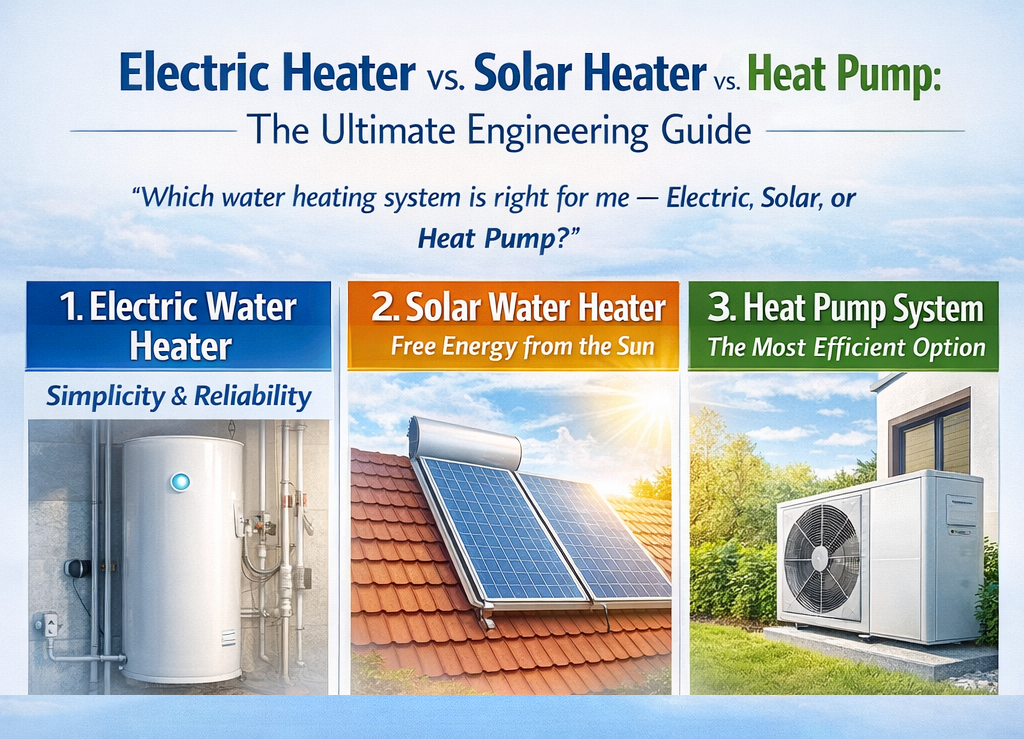
Once you have decided on electricity rather than gas, a second choice appears that matters far more to your long-term bill: whether to heat water with a plain resistive element, with the sun, or with a heat pump. These are not three brands of the same thing. They obtain energy in fundamentally different ways.
The Fundamental Difference
A resistive element converts. It turns electricity into heat, and it cannot do better than one unit of heat per unit of electricity. That ceiling is a law of physics, not a design limitation.
A solar collector captures. It gathers energy that arrives free and converts it to heat, so the running cost of the energy itself is zero. Its limitation is availability: it works when the sun shines.
A heat pump moves. It extracts warmth already present in the surrounding air and concentrates it into the tank. Because transporting heat costs far less than creating it, a heat pump delivers several units of heat for each unit of electricity consumed, comfortably exceeding the resistive ceiling.
Comparison Table
| Factor | Resistive electric | Solar thermal | Heat pump |
|---|---|---|---|
| Energy source | Purchased electricity | Free sunlight | Ambient air plus electricity |
| Heat per unit of electricity | One | Not applicable | Several |
| Upfront cost | Lowest | Higher | Higher |
| Running cost | Highest | Lowest | Very low |
| Weather dependent | No | Yes | Slightly |
| Roof area required | None | Significant | None |
| Needs backup | No | Yes | Usually no |
| Best suited to | Low or irregular demand | Sunny regions, steady demand | High steady demand |
Resistive Electric: Simple and Predictable
The lowest purchase price, the simplest installation and complete independence from weather. For apartments, small households, and buildings with modest or irregular hot water use, a well-insulated resistive storage heater remains an entirely sensible choice.
Its weakness is that every unit of heat is bought at full price, every day, forever. Where demand is large and constant, that adds up faster than the purchase price difference of the alternatives.
Solar Thermal: Lowest Running Cost, Needs Roof and Backup
Nothing beats free fuel. In high-irradiance regions a correctly sized solar system carries a substantial majority of annual hot water demand, and in the hotter months close to all of it.
Two conditions must hold. You need unshaded roof area with reasonable orientation, and you need backup, because weather varies and no building should depend on sunshine for a guaranteed service. Two design details also matter more than most buyers realise: evacuated tube collectors retain heat far better than flat plates in cool or cloudy conditions, and a pressurised tank preserves strong flow at upper-floor taps where gravity systems disappoint. See our solar water heaters.
Heat Pump: Efficiency Without Sunshine
The heat pump’s advantage is that it beats the resistive ceiling without depending on weather or roof area. Output is predictable year-round, which makes it particularly attractive for hotels, gyms, labour accommodation and any facility with large steady demand where running cost dominates the decision.
It has two practical requirements. It needs air movement around the unit, because that air is its heat source, so sealing it into a tight unventilated cupboard undermines the efficiency you paid for. And its purchase price is higher, which it recovers through running cost rather than up front. See our heat pump water heaters.
Thinking About Payback Honestly
Payback periods quoted online are usually meaningless because they depend on variables specific to you: local energy price, actual daily consumption, climate, and how well the system is sized.
The reliable principle is simpler. The larger and steadier your hot water demand, the faster solar or a heat pump repays its extra cost. A hotel or compound with heavy daily consumption reaches payback far sooner than a two-person apartment. If your consumption is small or irregular, resistive electric may genuinely be the rational economic choice, and there is no reason to pretend otherwise.
The Answer Is Often Two of Them
These technologies combine better than they compete.
- Solar plus electric element — the most common arrangement. Solar carries the base load; the element tops up when needed. Simple and inexpensive.
- Solar plus heat pump — solar covers sunny periods and the heat pump provides efficient backup, giving very low running costs with guaranteed supply.
- Heat pump plus storage — the heat pump runs steadily into a large tank so peak demand is met from storage rather than instantaneous capacity.
Specifying a single technology in isolation is usually a missed opportunity, particularly in buildings large enough for the running cost to matter.
Frequently Asked Questions
Which has the lowest running cost?
Solar, because its fuel is free, followed closely by a heat pump. Resistive electric is the highest because every unit of heat is purchased at full price.
Does a heat pump work in a hot climate?
Yes, and warm ambient air is favourable for it, since the warmer the surrounding air the more readily it extracts heat. The practical requirement is adequate airflow around the unit.
Can I add solar to an existing electric system?
Often yes, with solar pre-heating water and the existing system topping up. Feasibility depends on roof area, orientation and the current installation.
Is resistive electric ever the right choice?
Frequently. For apartments, small households and properties used irregularly, the low purchase price and simplicity outweigh running-cost savings that would take a long time to accumulate.
What Each Technology Costs You Over Time
The three options have opposite cost profiles, and understanding the shape of each is more useful than any quoted payback figure.
Resistive electric is cheap to buy and expensive to run, so its total cost rises steadily and never flattens. Solar is expensive to buy and close to free to run, so its total cost rises steeply at purchase and then almost stops. A heat pump sits between the two, with a higher purchase price and a running cost far below resistive.
Two conclusions follow. First, the more hot water you use, the sooner solar and heat pumps overtake resistive electric, because the running-cost gap compounds daily. Second, for genuinely low or irregular consumption, resistive electric can remain the cheapest option across the whole life of the equipment, and choosing it is not a compromise.
Practical Requirements You Should Check First
| Technology | Check before committing |
|---|---|
| Resistive electric | Electrical capacity for the power rating you need |
| Solar thermal | Unshaded roof area, orientation, structural mounting, backup provision |
| Heat pump | Air movement around the unit, space for the fan section, noise position |
Each of these has ended an otherwise sound specification. Solar systems installed on shaded roofs underperform permanently. Heat pumps sealed into unventilated cupboards lose the efficiency they were bought for. And instant electric units are frequently chosen for their size before anyone checks the supply can deliver the current.
A Simple Way to Decide
- Low or irregular demand, no roof access — resistive electric, well insulated and correctly sized.
- Steady household demand, unshaded roof — solar with electric backup in the same tank.
- High steady commercial demand — heat pump, optionally with solar carrying the base load.
- Large facility where interruption is unacceptable — solar or heat pump for economy, with conventional backup and redundancy for reliability.
Work It Out With Us
Tell us your building type, daily hot water demand, roof availability and local electricity price, and our engineers will recommend which technology, or which combination, makes sense. Email sales@eauchauffage.com or call +1 (905) 299-3382. See also villa solar water heaters.