










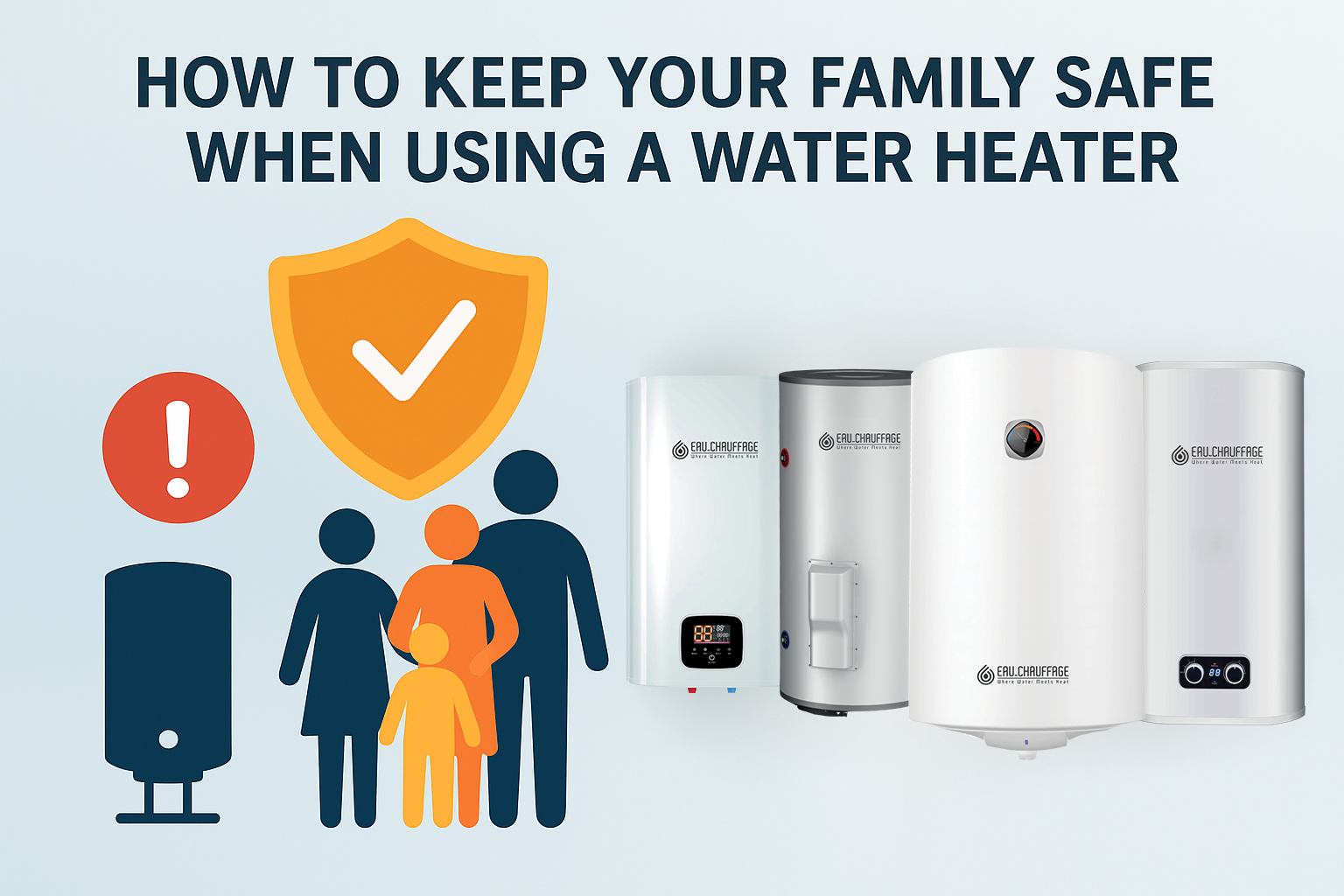
How to Keep Your Family Safe When Using a Water Heater

A water heater is one of the few appliances in a home that combines electricity, water and stored pressure in the same vessel, and runs unattended for years. Modern units are engineered to make that entirely safe, but the safety depends on devices being present, working and occasionally checked.
This guide covers the three real risks, the protections that address each, the warning signs worth acting on, and the extra care needed where children or elderly people are in the household.
Risk 1: Scalding
This is the most common water heater injury and the least discussed. Storage systems are often held hotter than any tap should deliver, for hygiene and to maximise usable stored volume. Without limiting or mixing at the outlet, that water reaches the tap at a temperature capable of causing serious burns quickly.
The risk rises sharply for children, whose skin is thinner, and for elderly people, who may react more slowly and have reduced sensation. In both cases the injury can occur in the time it takes to react.
- Use temperature limiting or a mixing arrangement at outlets used by vulnerable household members.
- Avoid raising the tank thermostat as a workaround for insufficient capacity; it increases risk without solving the shortage.
- Test water before placing a child in a bath, every time, rather than relying on the setting.
- Teach children to open the cold tap first and close it last.
Risk 2: Electrical Faults
An electric water heater places a powerful heating element inside water, in a room that is wet by design. Managed properly this is safe; the safeguards are mature and reliable.
Earthing and earth leakage protection form the primary defence. Leakage protection detects current escaping to earth, which is what happens when an element degrades, and disconnects the supply before it can reach a person. Confirm your unit has it and that the circuit is properly earthed.
An independent thermal cut-out is the second line. The thermostat manages normal operation; the cut-out exists solely for the case where the thermostat fails, removing power before water reaches a dangerous temperature. A unit with only a thermostat has no backup for that failure.
Never bypass a tripping protective device to restore hot water. A device that trips is reporting a fault, and the fault is the thing to investigate.
Risk 3: Pressure
Water expands as it heats. In a sealed steel vessel, if that expansion cannot escape, pressure rises. The pressure relief valve exists to release it, and it is genuinely safety-critical rather than a convenience fitting.
Relief valves can seize over time, particularly in hard water where deposits accumulate. This is why periodic testing matters: a valve that has never been operated is a valve nobody has confirmed works.
Equally, a valve that weeps or discharges continuously is signalling a problem, either excessive pressure or a failing valve, and should be investigated rather than ignored or plugged.
The Safety Package to Look For
| Device | What it protects against |
|---|---|
| Thermostat | Normal temperature control |
| Independent thermal cut-out | Thermostat failure and overheating |
| Earth leakage protection | Electrical fault reaching a person |
| Pressure relief valve | Excess pressure in the tank |
| Temperature limiting or mixing | Scalding at the outlet |
| Proper earthing | Electrical fault in wet conditions |
Every Eau Chauffage unit includes layered protection covering overheating, thermal cut-off and electrical leakage, manufactured under an ISO 9001:2015 certified quality management system with components meeting recognised UL and CE benchmarks.
Warning Signs Worth Acting On
- Any water around the base of the unit. A leaking tank does not repair itself and will worsen.
- A protective device that trips repeatedly. This is a fault report, not a nuisance.
- Water noticeably hotter than the setting. Suspect a failing thermostat.
- Rumbling, banging or knocking during heating. Usually sediment, which also raises running cost.
- Discoloured or metallic-smelling hot water. Often an early sign of internal corrosion.
- Continuous discharge from the relief valve. Investigate rather than cap it.
- Any burning smell or scorching near connections. Disconnect power and have it inspected.
Installation and Maintenance Basics
Most safety problems trace back to installation rather than the appliance. Have the unit installed by a qualified professional on a properly rated and earthed circuit, with the relief valve discharge routed safely, and with enough clearance to service it later.
Thereafter the routine is short: test the pressure relief valve periodically, inspect the anode rod and replace it when substantially consumed, drain sediment, and keep the area around the unit clear and dry. None of this is demanding, and all of it prevents the failures above.
Frequently Asked Questions
What temperature is safe?
There is a genuine tension: higher stored temperatures support hygiene and stored volume, lower delivered temperatures reduce scald risk. The usual resolution is to store adequately hot and limit or mix at outlets, rather than lowering the tank so far that hygiene or capacity suffers.
Are electric heaters safer than gas?
Electric removes combustion entirely, so there is no carbon monoxide risk and no flue to become blocked. It introduces electrical risk instead, which is managed by earthing and leakage protection. For indoor and enclosed spaces electric is generally the safer choice.
How often should the relief valve be tested?
Periodically, and more often in hard water where deposits can cause seizing. If you have never tested it, that is reason enough to do so.
Is it safe to leave a water heater on when away?
A properly installed unit with working protection is designed to run unattended. For long absences, switching off or reducing the setting saves standby energy, though systems in freezing climates need appropriate precautions.
Safety in Commercial and Shared Buildings
Hotels, labour accommodation, clinics, schools and gyms carry obligations a private home does not, because the people using the outlets did not choose the equipment and cannot inspect it.
Three differences matter. Delivered temperature must be controlled at outlets rather than trusted to a tank setting, since users include children, elderly guests and people unfamiliar with the building. Maintenance must be scheduled and recorded rather than left to whoever notices a problem. And plant rooms must remain accessible, because equipment that becomes hard to reach after a refurbishment stops being serviced.
Redundancy is also a safety consideration, not only an operational one. In a building where hot water supports hygiene, such as a clinic or a commercial kitchen, a single unit failing is more than an inconvenience. Cascading two smaller units preserves partial service during faults and maintenance.
A Simple Household Safety Routine
- Occasionally: glance at the area around the unit for moisture, staining or corrosion at the connections.
- Periodically: test the pressure relief valve, and listen for rumbling during a heating cycle.
- At intervals suited to your water: inspect the anode rod, drain sediment, and confirm the thermostat setting matches what you intended.
- After any building work: check that ventilation, access and drainage around the unit were not compromised by the alteration.
- Immediately, if anything trips or leaks: stop using the system and have it inspected rather than resetting repeatedly.
None of this takes long, and together it addresses every failure mode described above before it becomes an incident.
Questions About Your System?
If you are unsure what protection your current unit includes, or you are specifying for a building with children or elderly residents, our engineers can advise. Email sales@eauchauffage.com or call +1 (905) 299-3382. See our residential water heaters.