











Central Water Heaters: Benefits, Applications, and Why Stainless Steel Is the Optimal Choice

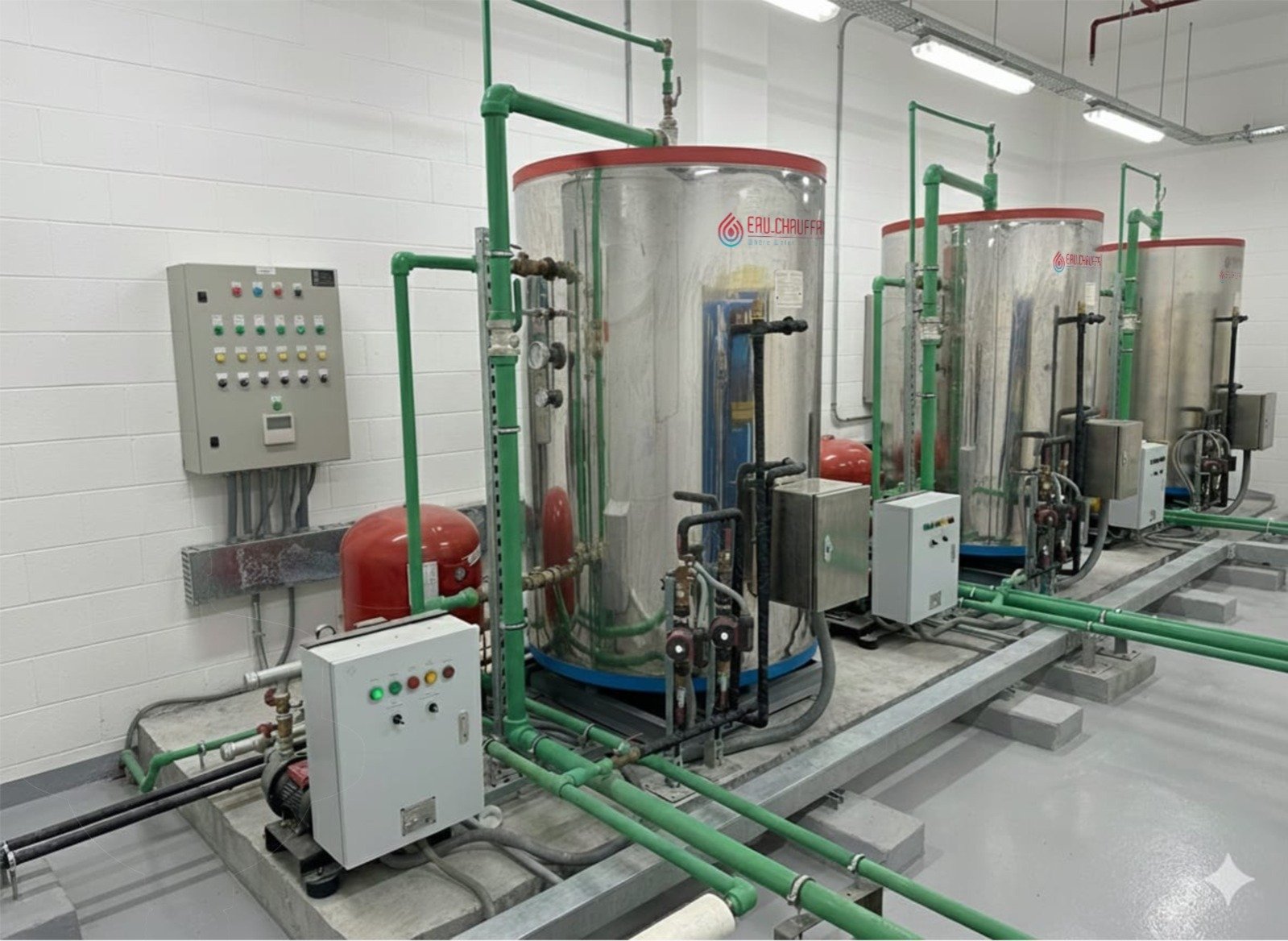
A central water heater heats and stores water in one place and delivers it to every outlet in the building. One tank, one connection, one point of maintenance. It is the standard approach for villas, apartment blocks, hotels and any facility where several taps draw hot water at the same time.
This guide covers how central systems work, when they beat point-of-use heaters, how to size one correctly, and the part most buyers overlook until it is too late: what the tank is made of, and why that single decision determines whether the system lasts five years or twenty.
What Is a Central Water Heater?
A central system heats water in a single insulated vessel and distributes it through the building’s pipework. The alternative, point-of-use heating, puts a small heater at each fixture. Both are valid; they simply solve different problems.
The defining characteristic of a central system is stored volume. Because a large reservoir of water is already hot, the system can serve several outlets simultaneously without the temperature collapsing. That is why hotels and villas use them, and why a single instant heater cannot replace one in a building with six bathrooms.
How a Central System Actually Works
Cold water enters the bottom of the tank. Heating elements raise it to the set temperature, and because hot water is less dense it rises to the top, where the outlet draws from. This stratification is deliberate: it means the hottest water is always what leaves first, and incoming cold water does not immediately dilute the whole tank.
A thermostat holds the set point, insulation slows heat loss between draws, and safety devices monitor temperature and pressure. When demand ends, the system reheats to standby and waits. The quality of each of those components decides both your running cost and the system’s lifespan.
The Real Benefits of a Central System
Consistent temperature at every outlet
Every tap draws from the same reservoir at the same temperature. There is no difference between the ground floor shower and the top floor one, and no cold shock when someone opens a tap elsewhere in the building.
Lower cost per litre of hot water
Heating equipment becomes more efficient per litre as capacity rises. A single 500-litre unit costs less to buy, install and run than five 100-litre heaters delivering the same total volume, because you pay once for the shell, the controls, the insulation and the installation labour.
One unit to maintain, not eight
This is the benefit owners underestimate most. Every heater in a building is a future service call, a future anode replacement and a future leak. Consolidating into one well-built unit reduces the maintenance burden proportionally, and puts that maintenance in a plant room rather than inside a finished bathroom ceiling.
Simpler electrical design
Multiple instant heaters each draw significant current while running, and running two at once can strain a domestic supply. A central system draws steadily over a longer period, which is generally easier for the building’s electrical design to accommodate.
Safety and air quality
Electric central systems produce no combustion products, so there is no flue requirement and no risk of carbon monoxide in enclosed spaces. Combined with overheating and pressure protection, this makes them well suited to residential buildings.
Central vs Point-of-Use: An Honest Comparison
Central systems are not always the right answer. Here is the trade-off without the sales gloss:
| Factor | Central system | Point-of-use (instant) |
|---|---|---|
| Simultaneous outlets | Excellent | Poor beyond one or two |
| Wait for hot water | Depends on pipe run | Almost immediate |
| Standby heat loss | Present, reduced by insulation | None |
| Best for | Villas, hotels, multi-bath buildings | Single bathrooms, kitchens, remote outlets |
| Maintenance points | One | One per fixture |
| Empty property | Still loses standby heat | Uses nothing |
In practice, larger buildings often use both: a central system for the main bathrooms, with an instant tankless heater serving a distant kitchen or guest suite where a long pipe run would waste both water and heat.
Why Tank Material Decides Service Life
Water heaters rarely fail because the element burns out. They fail because the tank corrodes and leaks. Hot water is chemically aggressive, and in regions with hard groundwater or desalinated supply it is more aggressive still. Everything else is repairable; a perforated tank is not.
Bare or painted steel
Cheapest to build and the shortest lived. With no barrier between hot water and the steel, corrosion begins immediately. Avoid it for any installation you intend to keep.
Enamel-coated (glass-lined) steel
A layer of vitreous enamel is fused to the steel at high temperature, sealing it from the water. This is the workhorse of the industry and, when paired with a maintained magnesium anode, delivers excellent service life at a sensible cost. Its one requirement is honest: the anode is consumable and must be inspected and replaced. Do that, and an enamel tank performs for many years. Ignore it, and the enamel’s inevitable microscopic imperfections become corrosion sites.
Stainless steel
Corrosion resistance is built into the metal rather than applied as a coating, so there is no lining to chip and far less dependence on anode maintenance. Stainless also holds pressure well, which is why it is the standard choice for pressurised solar tanks and demanding commercial installations. It costs more up front and rewards you over a longer horizon.
The practical conclusion: stainless steel is the strongest choice where budget allows or where the system is pressurised and hard-working. A quality enamel tank with a properly maintained anode remains an excellent, cost-effective option for most residential installations. The material that fails is the one nobody looks after. This is why Eau Chauffage builds enamel-coated tanks with magnesium anode protection across the residential range, and stainless steel construction for pressurised solar and demanding commercial duty.
The Magnesium Anode: The Cheapest Insurance You Will Ever Buy
Inside every enamel-lined tank sits a magnesium rod. Magnesium is electrochemically more reactive than steel, so corrosion attacks the rod instead of the tank walls. The anode is designed to be destroyed; that is its entire job.
An anode rod costs a small fraction of a replacement water heater. Once it is fully consumed, corrosion moves on to the tank. In hard-water regions the rod depletes faster, so inspection intervals should be shorter. Have it checked periodically and replaced when substantially consumed, and you may extend the tank’s usable life dramatically for a trivial cost.
Sizing a Central Water Heater by Building Type
The most common and most expensive specification error is sizing on daily consumption instead of peak-hour demand. A 40-room hotel and a 40-cover restaurant can use similar daily volumes, yet the hotel compresses nearly all of it into a ninety-minute morning window and therefore needs far more stored volume.
| Building | Typical starting capacity | Driving factor |
|---|---|---|
| Apartment, 1-2 bathrooms | 100-200 L | Occupancy |
| Family villa, 3-4 bathrooms | 300-500 L | Simultaneous showers |
| Large villa / compound | 500-1,000 L | Number of units |
| Clinic, school, small hotel | 1,000-2,000 L | Peak-hour draw |
| Hotel, gym, labour accommodation | 2,000 L and above | Concentrated peaks |
| Industrial process | Calculated per process | Continuous demand |
Treat these as starting points, not answers. The correct figure comes from fixture count, occupancy pattern and incoming water temperature, which varies considerably by season and region. Our central water heaters span 100 to 7,500 litres precisely so a system can be matched to the building rather than rounded up to the nearest stocked size.
Insulation and Standby Loss: The Cost You Never See
A central tank holds hot water continuously, so it loses heat continuously through its walls, and the elements fire to compensate. This standby loss runs every hour of every day, whether anyone is home or not, and it accumulates into a meaningful share of the annual bill.
High-density polyurethane (PUF) insulation is what limits it. Better insulation means the tank holds temperature longer, the elements cycle less, and both your energy cost and component wear fall. It also slows scale formation, because scale accumulates fastest on hot surfaces during heating cycles. Insulation thickness is not a glamorous specification, but over a fifteen-year life it is one of the most financially significant.
Five Specification Mistakes That Cost the Most
- Sizing on daily use instead of peak hour. The single most frequent error, and it produces a system that disappoints every morning.
- Ignoring water quality. Hard or desalinated supply changes which tank and which maintenance interval is appropriate.
- Buying on tank volume alone. Two 500-litre heaters can differ enormously in insulation, lining and recovery rate.
- Forgetting the anode. An unmaintained anode quietly converts a long-life tank into a short-life one.
- No redundancy in commercial buildings. One large unit is efficient until it fails and the hotel has no hot water. Cascading two smaller units preserves partial service during maintenance.
Maintenance That Actually Matters
- Inspect the anode rod periodically and replace when substantially consumed. More often in hard-water regions.
- Drain sediment from the tank base. Sediment insulates the element from the water, raising consumption and shortening element life.
- Test the pressure relief valve. It is a safety device and it can seize.
- Check the thermostat setting. Unnecessarily high settings accelerate scale and waste energy.
- Inspect insulation and pipework for damage, especially on exposed runs.
Frequently Asked Questions
Is a central water heater cheaper to run than several small ones?
Generally yes in buildings with multiple bathrooms, because you insulate and maintain one vessel rather than many, and the cost per litre falls as capacity rises. In a small apartment used intermittently, an instant heater can be cheaper because it has no standby loss at all.
What capacity do I need for a villa?
A family villa with three or four bathrooms typically starts around 300 to 500 litres, rising with occupancy and the number of bathrooms used simultaneously. Send us the fixture count and occupancy and we will size it properly.
Enamel or stainless steel: which should I choose?
Stainless steel where the budget allows, the system is pressurised, or duty is heavy. A quality enamel tank with a maintained magnesium anode is an excellent and more economical choice for most residential installations.
Can a central system work with solar?
Yes, and it is a strong combination. Solar carries the base load while the central tank guarantees supply through poor weather and peak demand. See our villa solar water heaters for pressurised systems designed to pair with stored backup.
How long should a central water heater last?
Service life depends far more on tank construction, water quality and anode maintenance than on brand claims. A well-built, well-maintained tank in reasonable water conditions lasts many years; the same tank with a fully consumed anode in hard water can fail far sooner.
Specifying Your System
Eau Chauffage manufactures central water heating systems from 100 to 7,500 litres under an ISO 9001:2015 certified quality management system, with enamel-coated and stainless steel construction, magnesium anode protection, PUF insulation and full overheating and pressure protection.
Tell us the building type, fixture count and expected occupancy and our engineers will recommend capacity and configuration, including whether a single unit or a cascaded arrangement gives better redundancy. Email sales@eauchauffage.com or call +1 (905) 299-3382.
Further reading: central electric water heater efficiency and safety, our commercial water heater range, and water heaters in Saudi Arabia for guidance on local water conditions.
Weighing the economics? See central vs individual water heaters for a full cost comparison and where the break-even point sits.