











Chauffe-eau solaires : Avantages, applications et pourquoi Eau Chauffage est à la pointe du progrès

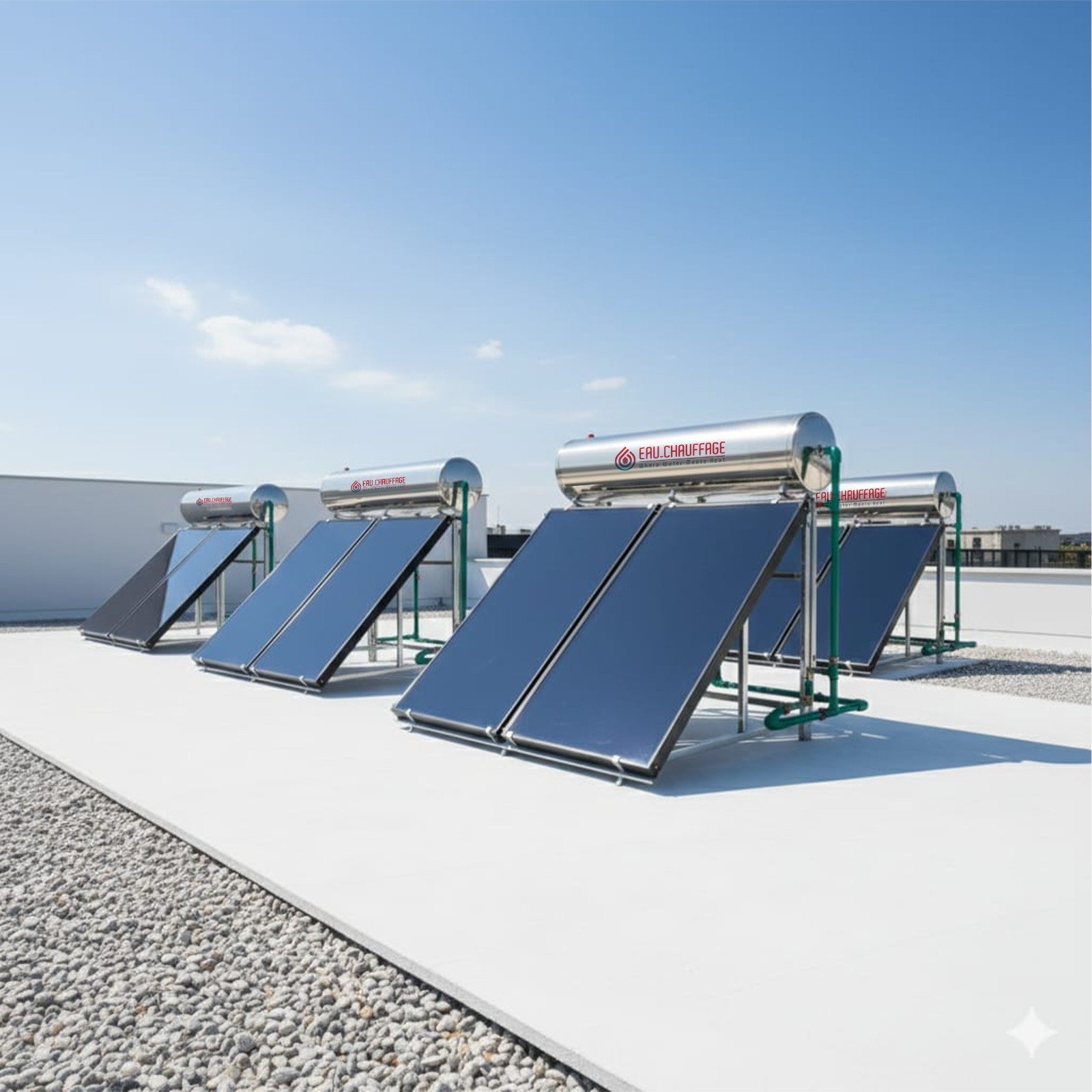
Le chauffage de l'eau est l'une des charges énergétiques les plus importantes et les plus prévisibles de tout bâtiment. Il fonctionne chaque jour, toute l'année, quelle que soit la saison. C'est exactement ce qui en fait le meilleur candidat pour le solaire : la demande est constante, si bien que l'équipement se rentabilise chaque jour plutôt que de façon saisonnière.
Ce guide explique comment fonctionne réellement le chauffage solaire de l'eau, ce qu'il économise de manière réaliste, comment dimensionner un système, et les choix de conception qui séparent un système qu'on oublie d'un système qu'on regrette. Pour la spécification des villas et des résidences avec capacités et détails de fabrication, consultez notre page dédiée sur les chauffe-eau solaires pour villas.
Comment fonctionne réellement un chauffe-eau solaire
Un chauffe-eau solaire comporte trois éléments essentiels : un capteur qui capte l'énergie solaire, une cuve isolée qui stocke l'eau chaude produite, et un circuit qui les relie.
Le capteur
Monté sur le toit et orienté vers le soleil, le capteur absorbe le rayonnement solaire et le convertit en chaleur. C'est là que se décide la qualité du système, car un capteur qui reperd sa chaleur vers l'air extérieur aussi vite qu'il la gagne décevra précisément les jours où vous le remarquerez le plus.
La cuve de stockage
L'énergie solaire arrive le jour ; l'eau chaude est surtout demandée tôt le matin et le soir. La cuve isolée comble cet écart. La qualité de l'isolation détermine quelle part de la chaleur collectée dans la journée reste disponible à 6 h le lendemain matin, et c'est pourquoi la construction de la cuve compte autant que la performance du capteur.
Circulation passive ou à pompe
Dans un système passif (thermosiphon), l'eau chauffée monte naturellement dans la cuve sans pompe ni électricité. Dans un système à pompe, un régulateur fait circuler le fluide lorsque le capteur est plus chaud que la cuve, ce qui permet un placement plus souple de la cuve mais exige de l'électricité pour fonctionner.
Cette distinction compte pour une affirmation que vous verrez répétée en ligne : que les chauffe-eau solaires continuent de fonctionner pendant les coupures de courant. C'est vrai pour les systèmes passifs, qui n'ont besoin d'aucune électricité pour collecter la chaleur. Ce n'est pas automatiquement vrai pour les systèmes à pompe de circulation ou à commande électronique. Demandez quel type on vous propose.
Tubes sous vide ou capteurs plans
Deux types de capteurs dominent le marché. Les tubes sous vide utilisent une couche de vide pour supprimer les pertes de chaleur ; ils conservent ce qu'ils captent et prennent l'avantage dès que l'écart entre le capteur et l'air extérieur est grand. Les capteurs plans sont plus simples et moins chers, et dans les climats constamment chauds avec une surface de toit suffisante, ils sont très compétitifs en rapport qualité-prix.
Aucun n'est universellement meilleur, et la réponse honnête dépend de votre climat et de la température visée. Pour la comparaison complète, y compris courbes de rendement, durabilité, nettoyage et stagnation, voir tubes sous vide ou capteurs solaires plans.
Sous pression ou sans pression : la différence que vous ressentez au quotidien
C'est la source de déception la plus fréquente avec l'eau chaude solaire, et elle n'a rien à voir avec la quantité de chaleur que le système collecte.
Les chauffe-eau solaires bon marché sont généralement sans pression : la cuve est ouverte à l'atmosphère et l'eau atteint vos robinets par la seule gravité. Dans un bâtiment de plain-pied avec une salle de bain, cela peut être acceptable. Dans une villa de deux ou trois étages, cela produit des douches faibles aux étages supérieurs et un mitigeage imprévisible, et les foyers reviennent discrètement au chauffe-eau électrique.
A sous pression maintient la pression du réseau dans une cuve en acier inoxydable, si bien que chaque point de puisage délivre le même débit puissant qu'avec un système conventionnel. Vous obtenez l'économie du solaire sans demander au foyer d'accepter une eau plus faible. Si vous prenez une seule décision de spécification au sérieux, que ce soit celle-ci.
Ce que le solaire économise réellement
Vous trouverez des sites promettant de très grands pourcentages fixes. Traitez les chiffres précis avec prudence, car la réponse honnête est que les économies dépendent de quatre choses : votre climat, la qualité du dimensionnement du système par rapport à votre usage, votre profil de consommation, et le prix de l'énergie que vous remplacez.
Voici ce qui peut être dit avec confiance. Dans les régions à fort ensoleillement comme le Golfe, un système solaire correctement dimensionné peut couvrir une large majorité de la demande annuelle d'eau chaude, et pendant les mois les plus chauds, presque la totalité. Les déficits surviennent en hiver, lors de longues périodes nuageuses, et lorsque la demande dépasse temporairement ce que la cuve a stocké, ce qui est précisément ce que l'appoint existe pour couvrir.
L'autre moitié du calcul est que le combustible est gratuit et permanent. Contrairement à une amélioration du rendement qui réduit une facture d'une proportion fixe, le solaire remplace l'énergie achetée par une énergie qui arrive sans coût pendant toute la vie de l'équipement. Pour transformer cela en un chiffre réel pour votre bâtiment, plutôt qu'un pourcentage tiré d'une brochure, suivez notre guide sur l' amortissement d'un chauffe-eau solaire, qui déroule le calcul étape par étape avec des exemples concrets pour une villa et un hôtel.
Ce qui détermine la performance de votre système
| Facteur | Pourquoi c'est important |
|---|---|
| Orientation et inclinaison du toit | Décide de la quantité de rayonnement que le capteur reçoit réellement |
| Ombrage | Même une ombre partielle aux heures de pointe réduit la production de façon disproportionnée |
| Surface de capteur et demande | Des capteurs sous-dimensionnés ne peuvent pas chauffer la cuve entièrement ; surdimensionnés, ils gaspillent du capital |
| Isolation de la cuve | Détermine quelle part de la chaleur du jour survit jusqu'au lendemain matin |
| Moment d'utilisation | Un usage concentré le soir convient mieux au solaire que des pics avant l'aube |
| Qualité de l'eau | Le tartre sur les surfaces internes réduit le transfert de chaleur avec le temps |
Dimensionnement : adapter la capacité au bâtiment
Eau Chauffage fournit des systèmes résidentiels compacts en capacités de 100, 150, 200 et 300 litres , et des systèmes commerciaux de 500 litres à 15 000 litres.
| Application | Capacité typique |
|---|---|
| Appartement ou petit foyer | 100-150 L |
| Maison familiale, 2-3 salles de bain | 200-300 L |
| Grande villa, 4 salles de bain ou plus | 500 L et plus |
| Résidences et logements du personnel | 1 000 L et plus |
| Hôtels, écoles, hôpitaux, usines | Jusqu'à 15 000 L |
Le dimensionnement solaire diffère du dimensionnement conventionnel sur un point important : vous adaptez non seulement le volume stocké à la demande, mais aussi la surface de capteurs à l'énergie solaire disponible à votre emplacement. Une cuve plus grande que ce que vos capteurs peuvent chauffer restera simplement partiellement chaude ; les deux doivent donc être spécifiés ensemble.
Où le chauffage solaire de l'eau est utilisé
- Villas et maisons familiales — le cas classique, avec une forte demande quotidienne et une surface de toit disponible.
- Résidences et logements du personnel — consommation importante et prévisible où le coût d'exploitation domine.
- Hôtels et centres de villégiature — forte demande soutenue, généralement avec un appoint conventionnel pour les pics.
- Écoles, cliniques et hôpitaux — demande diurne stable bien alignée sur la disponibilité solaire.
- Usines et installations commerciales — eau chaude de procédé à grande échelle, souvent aux côtés de nos systèmes industriels.
Appoint : pourquoi chaque système solaire en a besoin
Aucun système solaire ne devrait être spécifié sans appoint, et ce n'est pas une faiblesse de la technologie. La météo varie, et la demande dépasse parfois ce que la cuve a collecté. Un bâtiment qui ne peut pas garantir l'eau chaude est un bâtiment avec un problème, quelle que soit la qualité des capteurs.
L'appoint prend généralement l'une de deux formes. Une résistance électrique dans la cuve complète la température lorsque l'apport solaire est insuffisant, ce qui est simple et peu coûteux. Alternativement, une pompe à chaleur fournit un appoint à un coût de fonctionnement bien inférieur à celui d'une résistance, ce qui est attrayant lorsque les déficits sont fréquents ou la demande importante. Dans les deux cas, le solaire porte la charge de base et l'appoint garantit l'approvisionnement.
Maintenance
- Gardez les capteurs propres. L'accumulation de poussière et de sable est une réelle perte de production en climat désertique, et le nettoyage est le gain de performance le moins cher qui soit.
- Inspectez le châssis de fixation périodiquement pour la corrosion et le serrage des fixations, surtout sur les toits exposés.
- Vérifiez les composants de pression et les vannes comme sur tout système sous pression.
- Surveillez le tartre là où l'eau est dure, car les dépôts réduisent le transfert de chaleur.
- Vérifiez le fonctionnement de l'appoint avant l'hiver plutôt que de découvrir une panne la première semaine froide.
Questions fréquemment posées
Les chauffe-eau solaires fonctionnent-ils par temps nuageux ?
Oui, bien que la production baisse. Les capteurs réagissent au rayonnement diffus comme à la lumière directe, et les tubes sous vide retiennent ce qu'ils captent plus efficacement que les capteurs plans par mauvais temps. L'appoint couvre le déficit les jours vraiment mauvais.
Aurai-je encore de l'eau chaude la nuit ?
Oui. L'eau chauffée pendant la journée est stockée dans une cuve isolée, et c'est pourquoi la qualité de l'isolation détermine directement la quantité de chaleur encore disponible le matin.
Combien de temps dure un chauffe-eau solaire ?
Le solaire thermique comporte peu de pièces mobiles ; avec une construction résistante à la corrosion et une inspection périodique, ces systèmes offrent un long service. Le matériau de la cuve et la qualité du châssis comptent le plus, car tous deux sont exposés en permanence aux intempéries.
Le solaire peut-il remplacer entièrement mon chauffe-eau électrique ?
En pratique, il ne le devrait pas. Le solaire couvre extrêmement bien la charge de base, mais l'appoint garantit l'approvisionnement par mauvais temps et en cas de demande inhabituelle. La combinaison est plus fiable et, sur une année, procure encore l'essentiel de l'économie.
De quelle surface de toit ai-je besoin ?
Cela dépend de la capacité, du type de capteur et de la ressource solaire de votre emplacement. Envoyez-nous les dimensions, l'orientation et l'ombrage de votre toit ainsi que la taille du foyer, et nous spécifierons ensemble la surface de capteurs et la capacité de la cuve.
Spécifier un système solaire
Eau Chauffage fabrique des systèmes de chauffage solaire de l'eau sous pression avec cuves en acier inoxydable, capteurs à tubes sous vide et châssis en aluminium renforcé, de 100 litres pour les appartements jusqu'à 15 000 litres pour les grandes installations, selon un système de management de la qualité certifié ISO 9001:2015.
Indiquez-nous votre type de bâtiment, l'occupation, l'orientation du toit et la surface disponible, et nos ingénieurs dimensionneront ensemble capteurs et stockage et recommanderont l'appoint approprié. Écrivez à sales@eauchauffage.com ou appeler +1 (905) 299-3382.
Pour aller plus loin : notre gamme de chauffe-eau solaires, chauffe-eau solaires pour villas pour les grandes résidences, et chauffe-eau en Arabie saoudite pour les conseils régionaux.
Prêt à faire les calculs ? Voir comment dimensionner un chauffe-eau solaire pour votre toit pour la surface de capteurs, l'orientation, l'inclinaison et l'ombrage.