











Chauffe-eau central ou individuel : lequel coûte le moins cher ?

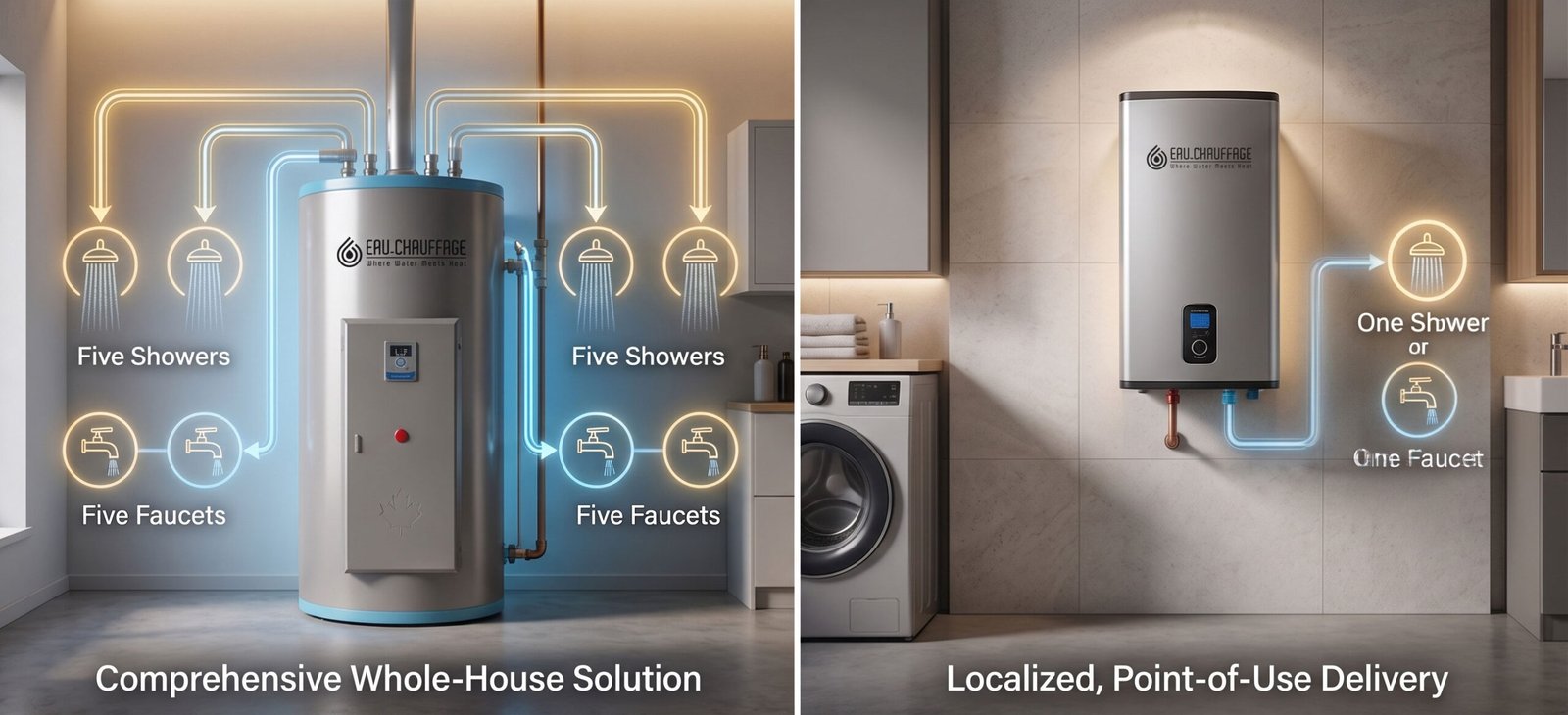
Faut-il installer un seul chauffe-eau central pour tout le bâtiment, ou une unité individuelle dans chaque salle de bain ? La plupart des conseils répondent sur la commodité. Cet article répond sur le coût, car sur quinze ans, c'est là-dessus que la décision se joue réellement.
Aucune option n'est universellement moins chère. Il existe un seuil de rentabilité, et savoir à peu près où il se situe pour votre bâtiment est tout l'exercice.
Les quatre coûts qui tranchent
Comparer les seuls prix d'achat est la façon dont les bâtiments se retrouvent avec le mauvais système. Il y a quatre flux de coût, et ils ne pointent pas dans la même direction.
| Poste de coût | Système central | Unités individuelles |
|---|---|---|
| Achat | Une unité plus grande | Plusieurs unités plus petites |
| Installation | Local technique plus tuyauterie de distribution | Emplacements multiples, câblage et raccordements |
| Fonctionnement | Une cuve perdant de la chaleur en veille | Plusieurs cuves perdant chacune de la chaleur en veille |
| Maintenance | Une anode, une soupape, une visite d'entretien | Multiplié par le nombre d'unités |
Le prix d'achat est le seul qui favorise les unités individuelles, et c'est aussi le plus petit des quatre sur la vie de l'installation.
Coût d'achat : pourquoi les litres coûtent moins cher en gros
Chaque chauffe-eau porte des coûts fixes quelle que soit sa taille : une enveloppe extérieure, un thermostat, des dispositifs de sécurité, une isolation, un emballage et un transport. Ces coûts changent à peine entre une unité de 50 litres et une de 300 litres.
Cela signifie que le coût par litre de stockage baisse à mesure que la capacité augmente. Quatre chauffe-eau de 80 litres vous donnent 320 litres, mais vous avez payé quatre fois l'enveloppe, les commandes, l'isolation et l'ensemble de sécurité. Une unité de 300 litres vous donne presque le même stockage en ayant payé tout cela une seule fois.
Pour une ou deux unités, la différence est faible. À la troisième ou quatrième, elle est généralement décisive.
Installation : le coût que personne ne chiffre
Les unités individuelles paraissent peu coûteuses à installer parce que chacune est simple. Le coût est dans la répétition.
Chaque unité a besoin de sa propre fixation, de ses propres raccordements d'eau, de son propre circuit électrique et de sa propre mise en service. Multipliez cela par quatre salles de bain et la main-d'œuvre seule dépasse souvent l'écart de prix des équipements. Dans une construction neuve, vous amenez aussi une capacité électrique dédiée à plusieurs emplacements au lieu d'un seul.
Un système central inverse l'échange. L'installation est concentrée en un seul endroit, mais vous payez la tuyauterie de distribution vers chaque point de puisage. Dans un bâtiment compact, cette tuyauterie est courte et l'option centrale gagne facilement. Dans une villa étendue de plain-pied avec des ailes éloignées, les longs tronçons érodent l'avantage, et une solution hybride s'avère souvent la meilleure.
Coût de fonctionnement : la perte en veille se multiplie
C'est ici que l'écart se creuse discrètement, chaque heure, pour toute la vie de l'installation.
Toute cuve contenant de l'eau chaude perd de la chaleur par ses parois en permanence, et la résistance se déclenche pour compenser, que quelqu'un utilise l'eau chaude ou non. Cette perte est à peu près proportionnelle à la surface plutôt qu'au volume, et plusieurs petites cuves ont une surface combinée bien supérieure à celle d'une seule cuve plus grande de capacité totale similaire.
Ainsi, quatre petits chauffe-eau ne coûtent pas seulement quatre fois l'entretien. Ils perdent de la chaleur par quatre surfaces distinctes, jour et nuit, pour toujours.
Il y a une exception importante, et c'est le plus fort argument en faveur du point d'utilisation. Un chauffe-eau instantané sans réservoir ne stocke rien, donc sa perte en veille est nulle. Pour un point de puisage utilisé occasionnellement, ou un bien laissé vide sur de longues périodes, cela bat tout système central sur le coût de fonctionnement, car une cuve centrale reste chaude pour un bâtiment où il n'y a personne.
Entretien : là où réside la différence à long terme
Chaque chauffe-eau a besoin des mêmes soins de routine : inspection de l'anode, élimination des sédiments et test de la soupape de sécurité. Rien de tout cela n'est coûteux individuellement.
Le problème des unités individuelles est que cette routine se multiplie, et qu'en pratique elle cesse d'être faite. Quatre chauffe-eau, ce sont quatre anodes à inspecter, souvent dans quatre positions peu pratiques à travers le bâtiment. Ce qui suit est prévisible : l'entretien est sauté, les anodes s'épuisent, les cuves se corrodent, et les unités tombent en panne tôt et à des moments différents, si bien que vous les remplacez une par une sur plusieurs années.
Une seule unité centrale dans un local technique accessible est entretenue, car c'est une visite pour une machine. Ce n'est pas une petite différence ; c'est souvent la différence entre un équipement qui atteint sa durée de service prévue et un équipement qui tombe en panne des années trop tôt.
Où se situe le seuil de rentabilité
| Situation | Généralement moins cher | Pourquoi |
|---|---|---|
| 1 salle de bain | Individuel | Aucun coût de distribution, aucun avantage d'échelle |
| 2 salles de bain, utilisées l'une après l'autre | L'un ou l'autre | Cas limite ; dépend de la disposition et des longueurs de tuyaux |
| 2 salles de bain ou plus utilisées simultanément | Central | Les unités individuelles ne peuvent pas satisfaire une demande simultanée à bas coût |
| 3 salles de bain ou plus | Central | Achat, perte en veille et entretien le favorisent tous |
| Point de puisage isolé et éloigné | Individuel (instantané) | Évite les pertes des longs tuyaux et l'attente |
| Bien inoccupé sur de longues périodes | Individuel (instantané) | Zéro perte en veille quand personne n'est là |
| Hôtel, résidence, logement de main-d'œuvre | Central, en cascade | Économies d'échelle plus redondance |
La règle pratique : si vous envisagez trois chauffe-eau séparés ou plus, un système central est presque certainement moins cher sur la vie du bâtiment. À un ou deux, c'est réellement une décision serrée que la disposition devrait trancher.
La réponse est souvent les deux
Traiter cela comme un choix binaire est l'erreur la plus courante de toute la comparaison.
La plupart des bâtiments bien conçus utilisent un système central pour les salles de bain principales, où la demande simultanée et les économies d'échelle s'appliquent toutes deux, plus une petite unité instantanée dans une cuisine éloignée, une suite d'invités ou des sanitaires du personnel où un long tuyau gaspillerait eau, chaleur et patience.
Cette formule hybride capte l'avantage de coût du stockage central sans payer pour acheminer l'eau chaude à travers le bâtiment vers un point de puisage utilisé deux fois par jour.
Ce qui ne change pas dans les deux cas
Quelle que soit la voie choisie, trois spécifications décident si vous obtenez l'économie que vous aviez prévue.
- Protection de la cuve. Revêtement émaillé avec une anode en magnésium entretenue, ou acier inoxydable. Cela décide de la durée de service plus que tout autre facteur.
- Qualité de l'isolation. Elle gouverne la perte en veille, qui est le coût de fond permanent dans les deux configurations.
- Dimensionnement correct. Une cuve centrale surdimensionnée gaspille de l'argent en permanence ; des unités individuelles sous-dimensionnées vous lâchent à la pointe. Voir quelle taille de chauffe-eau me faut-il.
Questions fréquemment posées
Un chauffe-eau central est-il moins cher que des unités individuelles ?
À partir de trois salles de bain environ, généralement oui, car le coût d'achat par litre, la perte en veille et l'entretien favorisent tous une seule unité. Pour une salle de bain, un chauffe-eau individuel est moins cher. À deux, cela dépend de la disposition.
Les chauffe-eau individuels consomment-ils plus d'électricité ?
Plusieurs petites cuves à accumulation perdent généralement plus de chaleur en veille au total qu'une seule cuve plus grande, car la surface totale est plus grande. Les unités instantanées sont l'exception : elles ne stockent rien, donc elles n'ont aucune perte en veille.
Lequel est le meilleur pour une villa ?
Central pour les salles de bain principales, surtout lorsque deux ou plus sont utilisées en même temps. Beaucoup de villas ajoutent une unité instantanée compacte pour une cuisine éloignée ou un espace du personnel plutôt que d'étendre la tuyauterie à travers le bâtiment.
Puis-je passer d'unités individuelles à un système central ?
Oui, bien que cela exige une tuyauterie de distribution et un local technique, c'est donc plus facile lors d'une rénovation. L'économie s'accumule par des coûts de fonctionnement et d'entretien plus bas plutôt que d'arriver immédiatement.
Et pour une résidence de vacances utilisée quelques semaines par an ?
Les chauffe-eau instantanés individuels gagnent généralement nettement. Une cuve centrale qui reste chaude pour un bâtiment que personne n'occupe est le coût de fonctionnement le plus évitable qui soit.
Faites le calcul pour votre bâtiment
Indiquez-nous votre nombre de salles de bain, le nombre de points de puisage utilisés simultanément, la disposition du bâtiment et les habitudes d'occupation, et nos ingénieurs vous diront quelle configuration coûte le moins cher dans votre cas précis, y compris si un hybride a plus de sens.
Courriel sales@eauchauffage.com ou appeler +1 (905) 299-3382. À lire aussi : systèmes de chauffage central de l'eau et systèmes d'eau chaude commerciaux.